
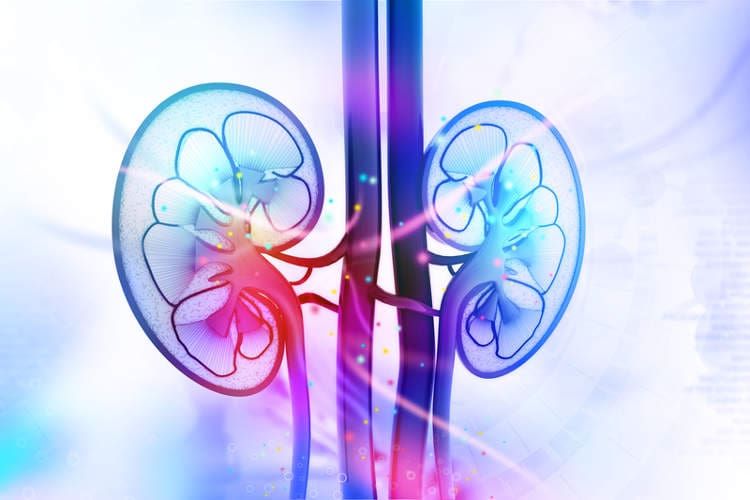
The kidneys are two bean-shaped organs that sit on either side of your spine (backbone) just below your rib cage. They are about the size of an adult fist. Their main role is to filter waste products from your body.

What do the kidneys do?
Each kidney contains about a million tiny filters called nephrons. These filters remove waste products from your blood, as well as excess water and some salts to make urine (wee). Your kidneys filter about 200 litres of blood every day.
Your kidneys are also involved in controlling blood pressure, making red blood cells and activating vitamin D in your body.
How the kidneys filter waste and make urine
Your body makes waste products that need to be removed by your kidneys. The main waste products that are removed in the urine are urea and creatinine. Urea is a chemical that is created when protein is broken down in the body, and creatinine is created as a by-product of normal muscle use.
Blood containing these waste products enters the kidneys via 2 major blood vessels — the renal arteries. Generally there is one renal artery for each kidney. Each renal artery then branches into smaller and smaller blood vessels, and your blood flows through these tiny vessels to the million or so filtration units within each kidney.
The filtration units, known as nephrons, are where waste products are removed from the blood. The nephrons are also involved in regulating the levels of salts (such as sodium, phosphorus and potassium) in the blood, so that they remain within the healthy range.
The waste products and any excess water and salt forms urine. Urine passes from each kidney down a tube called a ureter to the bladder where it is stored before leaving the body. The filtered blood which has been cleaned of waste products returns to the rest of the body via the renal vein.
Other functions of the kidneys
As well as the role they play in filtration, the kidneys have several other functions. These include:
- making erythropoietin (EPO), a hormone that stimulates your bone marrow to make red blood cells;
- converting vitamin D into its active form (calcitriol), which is needed to maintain healthy bones; and
- making renin, an enzyme that helps regulate blood pressure.
Diseases that affect the kidneys
There are a number of different diseases that can affect the kidneys. Two of the most common are diabetes and high blood pressure.
In people with diabetes, high blood glucose levels can damage the nephrons in the kidneys. This leads to a condition known as diabetic nephropathy, which is a common cause of kidney failure in Australia.
High blood pressure can cause damage to the small blood vessels in the kidneys, interfering with the kidneys’ filtering ability.
Urinary tract infections can also affect the kidneys. Kidney infections usually result from lower urinary tract infections that spread upwards to the kidneys. A bacterial infection of the kidneys is known as pyelonephritis.
Kidney stones or an enlarged prostate can block the outflow of urine from the kidneys and cause kidney damage.
Other types of kidney disease include:
- glomerulonephritis (inflammation of the nephrons);
- polycystic kidney disease (an inherited disorder where kidney tissue becomes replaced with cysts);
- reflux nephropathy (kidney scarring resulting from the backwards flow of urine from the bladder to the kidneys); and
- kidney cancer.
The above conditions can lead to chronic kidney disease (CKD) in some people. CKD is when the kidneys are not working properly due to kidney damage that has developed over months or years. Chronic kidney disease affects about one in 10 Australians. Early detection and treatment can significantly improve the outlook for someone with CKD.
Acute kidney injury is when kidney damage happens over a much shorter period – in just days. It can happen if you have conditions such as a severe infection, blood loss, severe dehydration or acute glomerulonephritis. It can also happen if you take certain medicines that can damage the kidneys or affect their blood supply. Most people recover from acute kidney injury, but it can increase your risk of developing chronic kidney disease.
How would I know if my kidneys were damaged?
Many people in Australia have kidney disease and are not aware of it. That’s because there are more nephrons in each kidney than we need to stay healthy, so sometimes it’s not until there is a significant amount of kidney damage that people start to experience symptoms.
Measuring the levels of urea and creatinine (waste products) in the blood can show how well your kidneys are working. Urea and creatinine levels rise when your kidneys aren’t functioning properly. Your creatinine level can also be used to estimate how many millilitres of blood your kidneys filter per minute – known as the estimated glomerular filtration rate (eGFR). This indicates how efficiently your kidneys are filtering your blood. Your eGFR is worked out using your blood creatinine level, age and gender, and gives a more accurate indication of your kidney function than the creatinine level on its own.
Testing a urine sample – urinalysis – can also help diagnose possible kidney disease. Urine can be tested for red and white blood cells, protein, albumin and glucose. Other tests that may be recommended to help diagnose kidney disease include imaging tests (such as a kidney ultrasound) or a kidney biopsy (tissue sample of the kidney that is examined under a microscope).
Kidney Health Checks are recommended by Kidney Health Australia for people considered to be at risk of chronic kidney disease. A Kidney Health Check involves having:
- a urine test (to test for albumin levels);
- a blood test (to test the levels of urea and creatinine, and to calculate the eGFR); and
- a blood pressure check.
Having these simple tests once every 1 to 2 years can show whether there is any sign of kidney disease.
What if my kidneys stop working?
Some people with chronic kidney disease do eventually have so much damage to their kidneys that they are no longer able to effectively filter their blood. This means that waste products start to build up in the body, eventually reaching toxic levels. Kidney disease that has reached this point is called end-stage kidney disease or kidney failure.
People with end-stage kidney disease need to have their blood filtered another way. The treatment options are dialysis or kidney transplant. Dialysis is an artificial way of filtering the blood, while a kidney transplant involves surgically transplanting a healthy kidney from a donor.
Sometimes people with acute kidney injury also need to have dialysis for a short time.
Can you live with one kidney?
Yes, you can live with one kidney. Some people are born with only one kidney or only one working kidney. Because our kidneys contain more nephrons that we need to stay healthy, you can lose an entire kidney without it affecting your health, provided that your other kidney is healthy.
People may need to have one of their kidneys removed if they have cancer in the kidney or a severe injury to the kidney (e.g. from a car accident). Sometimes people choose to donate one of their kidneys to a close relative who needs a kidney transplant. People who are accepted as kidney donors are able to live a normal, healthy life with one kidney.
Keeping your kidneys healthy
There are several things you can do to try to keep your kidneys healthy and working properly. These include:
- keeping fit and maintaining a healthy weight;
- not smoking;
- limiting your alcohol intake to fewer than 2 standard drinks per day;
- having regular blood pressure checks;
- making sure you drink enough fluids, especially in hot weather (water is the best choice); and
- being careful about what medicines you take.
If you are at increased risk of kidney disease, always check with your doctor or pharmacist before taking any medicine, including painkillers, antacids, complementary medicines, herbal medicines, multivitamins and food supplements. This is especially important if you take other regular medicines (such as blood pressure medicines), as the medicines could interact and damage your kidneys.
See your doctor for lifestyle advice that can improve your overall health as well as your kidney health.
