
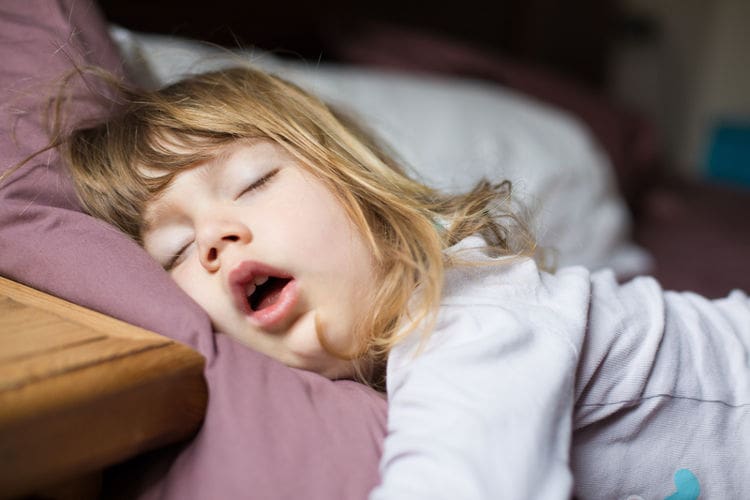
Obstructive sleep apnoea (OSA) is a condition that affects breathing during sleep. Affected children frequently snore and have poor quality sleep that can affect their behaviour and concentration during the day.
Obstructive sleep apnoea in children is most commonly caused by enlarged tonsils and adenoids. It usually affects children between the ages of 2 and 7 years when the tonsils and adenoids are at their largest compared to the rest of the airway. About 1-5 per cent of children in Australia are thought to have OSA, and girls and boys are affected equally.
Treating obstructive sleep apnoea allows your child to get more restful sleep. Once your child is sleeping well, improvements in behaviour and school performance usually follow.
Symptoms
Most parents of children with obstructive sleep apnoea notice that their child regularly snores or has noisy breathing when sleeping. Children with OSA usually snore at least 3 or more nights of the week. Children who only snore occasionally are less likely to have OSA.
Kids with OSA may also make gasping or choking noises, or even have pauses in their breathing during sleep. They may be restless during sleep, and you may find that your child prefers sleeping in positions with their neck extended (where the head is tilted backwards).
Other nighttime symptoms may include:
- sweating during sleep;
- breathing through the mouth rather than the nose (mouth breathing) while asleep;
- sleep walking or talking;
- wetting the bed; and
- waking up at night.
Daytime symptoms associated with OSA may include:
- mouth breathing;
- hyperactivity;
- difficulty concentrating;
- behavioural problems;
- learning difficulties or poor performance at school; and
- excessive sleepiness, especially in the morning.
Some children with OSA may be underweight or slow to gain weight. It’s thought that this is due to the increased work of overnight breathing using up extra energy.
Causes of obstructive sleep apnoea in children
The most common cause of obstructive sleep apnoea in children is enlarged tonsils and adenoids. Because of their location, enlarged tonsils and adenoids can cause airway narrowing. (Your tonsils are found on either side at the back of your throat, and your adenoids are found high up in the throat, behind the nose and the roof of your mouth.)
Other causes of OSA in childhood include:
- overweight or obesity;
- hay fever (allergic rhinitis);
- disorders that affect muscle tone; and
- anatomical factors such as a small jaw, flat face or enlarged tongue that may be associated with certain medical conditions, including Down syndrome.
What happens when children with OSA are asleep?
Children who already have a narrow airway can develop a partially obstructed airway when they are asleep because the muscles in the walls of the throat relax during sleep. So affected children have brief episodes where their airway partially obstructs and they cannot breathe in as much air as usual. When this happens, their oxygen levels may drop and their blood pressure may go up. Their body responds by waking up enough to open up their airway and restore normal breathing. This happens repeatedly during the night, so sleep is constantly being disrupted.
Complications of obstructive sleep apnoea
Children with untreated OSA may have problems with attention and behavioural issues that are caused by lack of good quality sleep and/or episodes of lowered oxygen levels. Memory and learning can also be affected. The impact of these on school and social situations can be significant.
Obstructive sleep apnoea may also be associated with attention deficit disorder in some kids.
Episodes of high blood pressure during sleep in childhood may possibly increase the risk of ongoing high blood pressure in adulthood.
Diagnosis
Your doctor will ask about your child’s sleep habits and what you have observed when your child is sleeping. They will also check to see if your child tends to breathe through their mouth rather than their nose (mouth breathing), and ask about daytime symptoms, including tiredness and hyperactivity.
The physical examination will include looking inside the mouth for enlarged tonsils (which can be easily seen when you open your mouth wide). Your doctor may also examine your nose, looking for possible swelling due to hay fever. It’s not possible to see your adenoids without using special instruments or taking X-rays.
Children with obvious enlargement of the tonsils and typical symptoms of OSA may not need further tests – your doctor may refer your child to an ear, nose and throat surgeon at this stage for removal of the tonsils and adenoids. Alternatively, if more tests are needed, your doctor may refer you to a paediatric sleep physician (doctor specialising in children’s sleep problems).
Sleep studies and other tests
One simple test that can help in the diagnosis of OSA is overnight measurement of your child’s oxygen levels. This can easily be done at home. Your child will place a small device that measures their blood oxygen level – a pulse oximeter – on one of their fingers for the night. This can show whether there are repeated dips in the blood oxygen level during sleep. If the test shows evidence of OSA, further testing is often not needed.
In some children, a full sleep study (polysomnography) may be needed to diagnose OSA. This test is the most accurate way of diagnosing and assessing the severity of obstructive sleep apnoea, and involves an overnight sleep at a specialised paediatric sleep unit. You may have to go on a waiting list to have a sleep study, as they are generally only done in specialist centres in Australia.
During a sleep study, several sensors that are connected to wires or cords are attached to your child’s head and body. Once your child falls asleep, the sensors monitor and record their breathing and oxygen levels. Blood pressure and heart rate may also be checked. Sleep quality is also assessed by monitoring the activity of the brain, eyes and muscles during sleep.
Sleep studies are not painful, but it can sometimes be difficult to get young children to co-operate if they feel uncomfortable and not want to have the various sensors attached. You can stay overnight with your child during the test.
Treatment of OSA in children
The recommended treatment will vary depending on the cause and severity of your child’s obstructive sleep apnoea.
If your child has OSA due to enlarged tonsils, your doctor will most likely recommend your child has their tonsils and adenoids removed. While not all children with OSA will need to have their tonsils and adenoids removed, many do. Surgical removal of the tonsils and adenoids (adenotonsillectomy) cures OSA in about 80 to 90 per cent of cases where there are no other medical problems. Following surgery, symptoms generally improve.
Children with OSA related to overweight or obesity may be advised to lose weight. Your doctor may recommend you see a dietitian to help work out a nutritious diet that will help with weight loss, as well as increased physical activity.
Children with hay fever and mild OSA may benefit from a trial of medication to treat the hay fever. A corticosteroid nose spray, such as mometasone (Nasonex), may help reduce inflammation and swelling in the nose and may also reduce the size of the adenoids. Montelukast (Singulair), a leukotriene receptor antagonist, can also be used to treat seasonal hay fever and may help children with OSA. Treatment for hay fever also involves avoiding the things you are allergic to, where possible.
Certain dental treatments, devices or mouthpieces may help open up the airway, but further research is needed to show that dental treatments are effective for treating children with OSA.
If obstructive sleep apnoea persists after treatment, your child may be given a CPAP (continuous positive airways pressure) machine to help keep their airway open at night. To use a CPAP machine, you need to wear a fitted mask over the nose (or nose and mouth). The mask is connected to a machine that keeps your airway open using positive air pressure. It can take a little while to get used to using a CPAP machine, but most people find that their improved symptoms are worth it.
Craniofacial surgery may be needed in rare cases where OSA is due to anatomical problems with the airway.
Talk to your doctor if your child has symptoms of obstructive sleep apnoea – early diagnosis and treatment can relieve symptoms and help your child avoid complications.
