
What is Down syndrome?
Down syndrome is a disorder of our genetic material and currently is the most common cause of intellectual disability. Down syndrome occurs in around one in 1100 births in Australia.
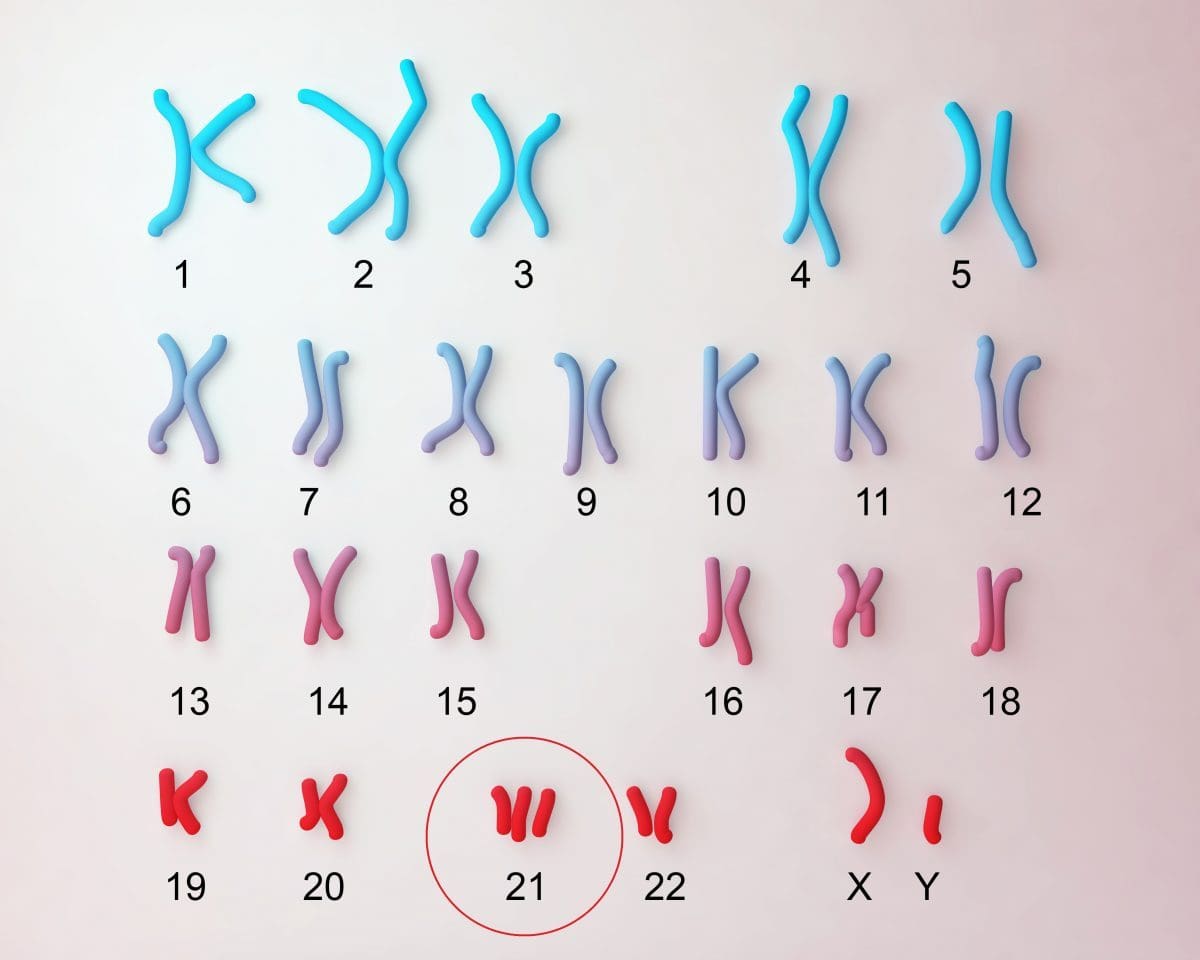
Usually, we humans have 23 pairs of chromosomes – the threadlike structures containing our DNA and genes. This number and arrangement of chromosomes determine a person’s development. In Down’s syndrome, instead of having 2 copies (the pair) of chromosome 21, there is an extra copy, making 3. For this reason, the condition is also called Trisomy 21. This extra copy of chromosome 21 is present in the cells of the body and is responsible for the typical features of Down syndrome.
Symptoms
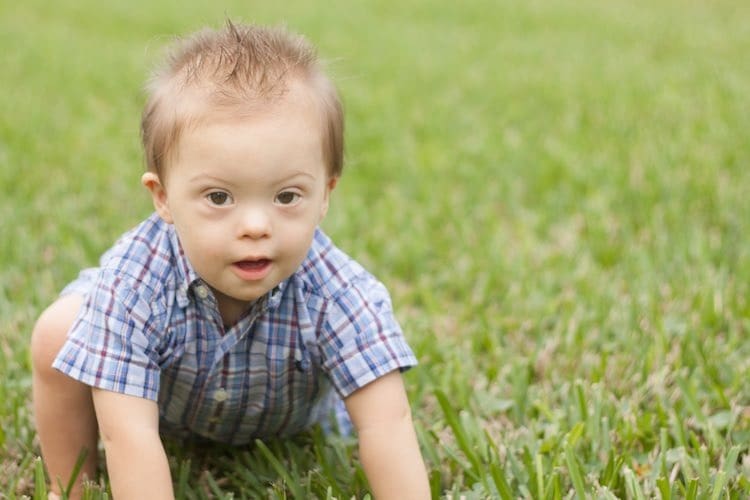
Children with Down syndrome are born with a characteristic physical appearance. Some of the features include upward slanted eyes, a flat nose on a round head and abnormalities on the palms of the hands and the soles of the feet. Adults and children with Down syndrome are commonly smaller than other people of their age.
In people with Down syndrome, there is usually some delay in development and a degree of intellectual and learning disability. Language and memory are usually affected. The severity varies from person to person.
People with Down syndrome are more likely to have other birth defects, such as in the heart or bowel. Down syndrome is also often associated with health problems such as hearing and vision problems.
The life expectancy for a person with Down syndrome is about 50 to 60 years old and continues to increase due to advances in medicine and community resources.
Complications
There are several long-term health issues associated with Down syndrome. These can include hypothyroidism (an under-active thyroid gland), obstructive sleep apnoea leukaemia, early-onset dementia, epilepsy and depression in adulthood.
There is no evidence for any therapy that can be done to prevent leukaemia, dementia and epilepsy; parents and doctors should be aware of the increased likelihood of these conditions to look for early warning signs.
Causes
We do not know what causes Down syndrome but we do know how it happens. It is most often due to abnormal cell division in the egg cell or sperm cell before they fuse to create an embryo.
Risk factors
While older women are at higher risk, women of any age can have a baby with Down syndrome. The risk increases in women from age 35 years and continues to increase as you get older.
Prenatal tests for Down syndrome
Prenatal tests for Down syndrome are offered to all pregnant women, but not all women choose to have them. Screening tests identify those at higher risk of having a baby affected by Down syndrome. There are also tests that can be done in the early stages of pregnancy to find out if the baby has Down syndrome – these are called diagnostic tests.
It’s important to be fully informed before having any of these tests, as you may be confronted with a decision if the tests come back positive. Your doctor will help guide you on what’s best for you and your pregnancy.
Screening tests
Screening tests give you a percentage chance of whether you are carrying a baby with Down syndrome. Screening tests are not perfect; they may give a false-positive result (indicating the baby has Down syndrome when it doesn’t), and they may not identify a baby which does have Down syndrome (false-negative). But many women choose to have screening tests because unlike diagnostic tests (see below) they don’t carry the small risk of causing a miscarriage.
There are 3 types of screening tests:
Combined first trimester screening (CFTS) – This test combines blood test results, your age and an ultrasound of the baby’s neck (nuchal translucency scan, done at 11-13 weeks) to calculate the risk of your baby having Down syndrome. There is a partial Medicare rebate for the blood test but there is an additional cost for the nuchal translucency ultrasound.
Second trimester maternal serum screening – This test combines a blood test with your weight and age and gestational age (age of the pregnancy in weeks) to estimate the Down syndrome risk. This test is not as accurate as CFTS and is usually only recommended for women who did not have testing earlier in the pregnancy.
Non-invasive prenatal testing or screening (NIPT or NIPS) (also known as cell free DNA/cfDNA) – This test, done from 10 weeks, involves a blood test that examines DNA from the baby that has entered the mother’s bloodstream. It’s the most accurate screening test currently available. Currently, NIPT is only available through private clinics and not covered through Medicare nor covered by private health. This test is often referred to by brand names, including Harmony test or Precept test.
If your screening results come back in the high-risk category you will be offered diagnostic testing. Some women may choose not to have diagnostic tests, and others may choose to go straight to having diagnostic testing, skipping screening tests altogether.
Bear in mind that most people who get a high-risk result from screening tests have a normal result from their diagnostic test.
Diagnostic tests
Diagnostic tests for Down syndrome can tell you whether your baby has Down syndrome – they are 99.9% accurate. But unlike screening tests they carry a small risk of miscarriage (up to or equal to 1%).
The diagnostic tests include chorionic villus sampling (CVS) and amniocentesis. Both these tests involve having a procedure where a needle is inserted into your abdomen (tummy) to take a sample of fetal cells (cells from the developing baby). The cells are taken from either the placenta or amniotic fluid (the fluid that surrounds the baby). CVS is performed from 10 – 13 weeks and amniocentesis from 15 weeks.
Remember, the decision to have any or all of these tests is yours. Talk to your general practitioner (GP), midwife or obstetrician for more information on these tests.
Tests and diagnosis in newborn babies
If a baby is born with physical features that are characteristic of Down syndrome, a blood test from the baby can confirm the diagnosis. The blood test is called a chromosomal karyotype.
Treatment of Down syndrome
Treatment depends on your particular needs and stage of life. Treatments that are usually started early in childhood and tailored to the needs of your child.
Most children with Down syndrome see several different doctors and specialists (including a paediatrician – specialist in children’s health).
Various other healthcare professionals are also usually involved in treatment, including:
- physiotherapists;
- speech pathologists;
- occupational therapists;
- optometrists;
- psychologists; and
- audiologists (specialists in hearing care).
Your GP can help to coordinate all the teams involved in your child’s care.
An educational plan made for your child can assist in the transition to becoming an independent adult.
Caring for someone with Down syndrome
Caring for someone with Down syndrome can be very draining emotionally and physically. Parents are encouraged to seek support from their GP. Support groups and workshops can connect you to other parents raising a child with Down syndrome. Additionally, there are lots of online resources that answer common questions parents have about their child with down syndrome. State-run Down syndrome websites have excellent information under the services and resources tabs.
Resources
https://www.downsyndromevictoria.org.au/
https://www.downsyndromensw.org.au/
The National Disability Insurance Scheme (NDIS) is Australia’s first national support for people with disability and is available in all states except Western Australia, where it is still rolling out. There is also an Early Childhood Early Intervention (ECEI) scheme that aims to provide increased support for children with developmental delay. Go to https://www.ndis.gov.au/ to see if you can access these schemes.
People with Down syndrome are individuals and have goals just like anyone else. They strive to have a meaningful job, close circle of friends, place to live and lasting relationships. It may be harder to reach these goals, but with support from community and family these are much more achievable.
