
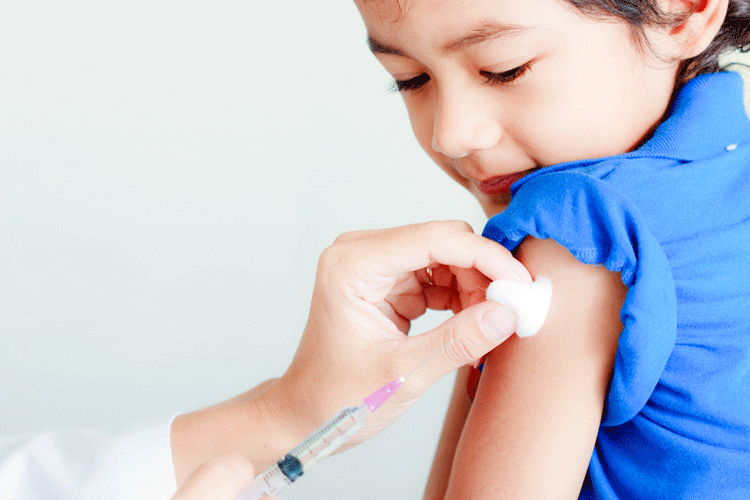
After the provision of safe food, water and sanitation, the most important public health measure in the world is vaccination.
Many infectious diseases, previously responsible for millions of deaths, are being controlled through vaccination. Some, such as smallpox, have now been eradicated.
The purpose of vaccination is to produce immunity.
Immunity means the presence in a person’s body of cells and substances known as antibodies that can produce a protective immune response. The immune cells and antibodies attack viruses and bacteria or the toxins they produce, stopping them from multiplying and causing disease.
Antibodies are specific to each individual disease. Having antibodies to measles does not protect you from catching mumps or chicken-pox, etc.
Active and passive immunisation
Immunisation means the creation of antibodies in a particular individual. This can happen in one of 2 ways.
- Active immunisation: this happens by being exposed to a disease causing organism, either by catching it in the normal way or through vaccination with a dose of the responsible virus or bacteria which has been killed or inactivated. Active immunisation is usually long lasting. It may take some time to fully develop and often needs ‘boosting’.
- Passive immunisation: this is a way of giving immediate immunity by injecting already existing antibodies (from someone else) into a person who has just been, or may shortly be, exposed to a particular infection. Passive immunity is immediately effective, but doesn’t last for long.
Childhood immunisations
The creation of immunity through vaccination is usually started at birth. In Australia as part of the National Immunisation Program Schedule, children are immunised against:
- hepatitis B;
- tetanus;
- whooping cough;
- diphtheria;
- haemophilus influenzae B (HiB);
- polio;
- pneumococcal disease;
- rotavirus;
- meningococcal serogroups A, C, W-135 and Y;
- measles, mumps and rubella (german measles);
- chickenpox; and
- human papillomavirus (HPV).
Influenza, meningococcal B, or Hepatitis A vaccination may also be recommended for certain at-risk groups as part of the National Immunisation Program Schedule.
Adult immunisations
As well as being of vital importance in childhood, vaccination is also essential for adults. Adults should remain immune to the following infections.
- Tetanus: booster vaccination is recommended at age 50 years for those who have not received a tetanus booster in the previous 10 years. Booster doses are also recommended for those travelling overseas who have not received a tetanus booster in the previous 10 years; and after sustaining a tetanus-prone wound if more than 5 years has passed since the last tetanus vaccination.
- Diphtheria: given in combination with tetanus.
- Whooping cough: vaccination against whooping cough (pertussis) is recommended for any adult who wishes to reduce the chance of becoming ill with whooping cough. Booster doses are especially recommended for all adults planning a pregnancy, new parents, and for grandparents and other people caring for young children.
- Polio: still present in less developed parts of the world. Booster doses are recommended for adults travelling to affected areas.
- Measles, mumps and rubella (German measles): childhood infection or vaccination usually gives life-long immunity. But these infections can cause serious illness in adults who didn’t have them, or were not vaccinated as a child. It is very important that pregnant women are immune to rubella. People born since 1966 who are not certain that they are immune (through infection or vaccination) should be vaccinated, especially if they are planning overseas travel.
- Hepatitis A: an infection caused by eating/drinking unclean food or water. Vaccination is recommended before travel to certain regions and for people at risk.
- Hepatitis B: a serious illness which can have permanent effects. Spread by contact with body fluids (e.g. blood, saliva, semen) of an infected person. Active immunity is possible with a series of 2 or 3 injections, and can be given in combination with hepatitis A vaccine.
- Influenza: a yearly vaccination is recommended for all people who want to reduce the chance of becoming ill with influenza. Vaccination is especially important for adults aged 65 years and older, pregnant women and those at risk of complications.
- Pneumococcal disease: vaccination is recommended for non-indigenous adults aged 70 years and older, indigenous adults aged 50 and older, and those at medical risk.
- Herpes zoster: herpes zoster – shingles – causes a painful skin rash. A single dose of zoster vaccine is recommended for most adults aged 60 years or older who have not previously been immunised.
Immunisation is simple, safe and readily available. If you have any doubts about your own immunity, or if you travel overseas frequently, see your doctor and check that you are adequately protected. If travelling overseas, remember that it takes at least 2 weeks to develop immunity after a vaccine, and some vaccines need more than one dose, several weeks apart. So make sure you see your doctor well in advance of your departure to discuss travel vaccinations.
