
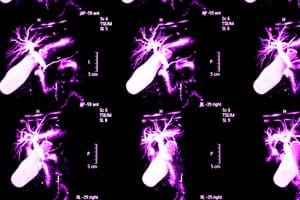
What is MRCP?
Magnetic resonance cholangiopancreatography (MRCP) is a technique for viewing the bile ducts and the pancreatic duct. It can also show the pancreas, gallbladder and liver. MRCP uses magnetic resonance imaging (MRI) to produce detailed pictures of these ducts and organs.

When is MRCP used?
MRCP can show gallstones, narrowing or blockages in the bile duct or the pancreatic duct, tumours, and evidence of inflammation.
MRCP may be used to help determine the cause of:
- jaundice;
- pancreatitis (inflammation of the pancreas);
- liver disease; or
- upper abdominal pain.
MRCP may be recommended to help diagnose cancer of the bile duct or pancreatic cancer. It is also often used in the diagnosis of a condition called primary sclerosing cholangitis. This condition causes narrowing of the bile ducts and is commonly associated with inflammatory bowel disease.
MRCP may also be recommended to help determine the severity of certain conditions or find out whether there are complications.
MRCP is a safer alternative to a more invasive test called endoscopic retrograde cholangiopancreatography (ERCP). ERCP is a procedure that involves the use of endoscopy, contrast medium and X-rays. Because ERCP is invasive, there are risks involved with this test, including inflammation of the pancreas, infection, bleeding and perforation of the bowel or bile duct.
However, sometimes ERCP is recommended because additional procedures can be performed during an ERCP that cannot be performed during MRCP. These procedures can help with diagnosis or treatment – examples include getting tissue samples (biopsies), removing a gallstone or inserting a stent to keep a bile duct open.
How does magnetic resonance imaging work?
Magnetic resonance imaging uses radiofrequency waves directed at the body to excite hydrogen atoms in the molecules of water in your body. This is done in a strong magnetic field, which causes the protons in the nuclei of your hydrogen atoms to line up, rather than being in random positions. These protons emit radio signals when they return to their natural alignment. The signals are used to build a computerised image that shows differences in body tissues based on the amount of water in them. This enables extremely clear and detailed pictures to be obtained.
How is MRCP done?
MRCP is an outpatient procedure that involves lying very still in an MRI scanner for several minutes at a time. You do not feel anything while the scan takes place, although the machine is quite noisy. The entire experience should be over in less than 20 minutes.
Contrast medium (special dye that can highlight certain areas on scans) is not usually needed for MRCP. When contrast is given, it can be given intravenously (through a drip into a vein).
Having an MRCP does not expose you to any radiation. However, because MRCP uses a strong magnetic field, people with some types of metal objects in their body cannot have this test.
Ask the centre performing the scan for advice if you have any of the following inside your body:
- metal clips to close off an aneurysm (expanded blood vessel);
- an artificial heart valve, cardiac pacemaker or defibrillator;
- metal coils in blood vessels;
- a joint replacement;
- a cochlear (inner ear) implant; or
- any other metal objects.
Preparation for the test
You cannot wear any jewellery or metal hair accessories during an MRI scan.
You may be asked to not have anything to eat or drink before an MRCP – check with your doctor or the radiology centre where you are having the test.
MRI tests are generally not recommended during pregnancy, especially during the first 12 weeks of pregnancy. If there is any possibility that you could be pregnant, let your doctor or the radiographer (medical imaging specialist) know.
Some people find it unpleasant being in the enclosed space of the MRI scanner, especially as it is quite noisy. If you experience claustrophobia (fear of confined spaces) or anxiety, or are worried about how you will feel during the test, your doctor may prescribe a mild sedative to take before the test. Some MRI machines are open on the sides, and are more tolerable for those with anxiety.
Many centres provide headphones or earplugs to protect your ears from the noise.
Are there any risks associated with MRCP?
MRI scans, including MRCP, are generally very safe.
There is no exposure to radiation with MRI scans.
There is small risk of an allergic reaction to the contrast medium that is sometimes used. People with severe kidney disease may not be able to have contrast medium as it very rarely causes organ damage in these people.
MRI scans should be avoided in the first trimester of pregnancy unless medically necessary.
Results
The images from the MRCP will be reviewed by a radiologist (doctor who specialises in medical imaging), who will write a report on the findings. The results will be sent to your GP and/or specialist.
