
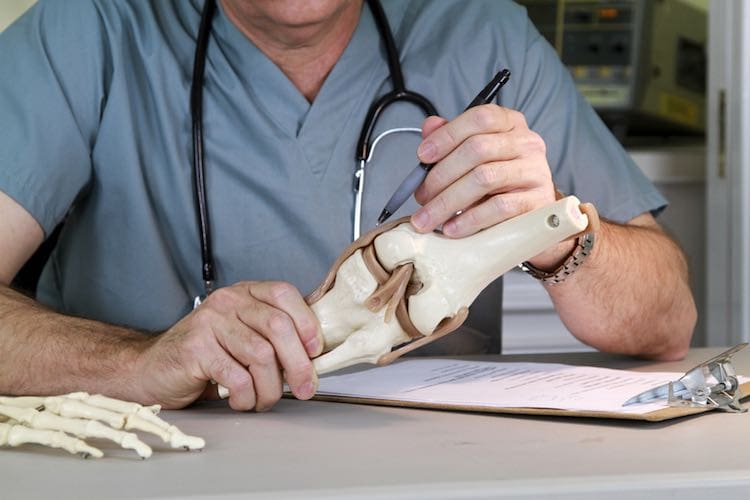


The knee is the largest joint in your body, forming a hinge between your femur (thigh bone) above, and the bones of your lower leg — the tibia (shin bone) and fibula — below.
Strong bands of fibrous tissue called ligaments help stabilise the knee joint and align the bones that meet at the knee.
There are 2 main sets of ligaments in the knee joint: the collateral ligaments, which run along either side of your knee joint, and the cruciate ligaments, which sit inside your knee joint.
Collateral ligaments
The lateral collateral ligament strengthens the knee joint on the outer side of the knee. It runs between your femur (thigh bone) and the top of your fibula — the long, thin bone adjacent to the tibia.
The medial collateral ligament strengthens the knee joint on the inner side of the knee. It runs between your femur and the upper inside edge of your tibia (shin bone).
Together the collateral ligaments resist side-to-side movement of the knee joint and help prevent rotation between your thigh bone and your shin.
Collateral ligament injuries
The lateral collateral ligament can be torn when your knee twists, is hit on the inner side, or is forced outwards while your foot is pushed inwards. A lateral collateral ligament tear rarely occurs on its own, and usually accompanies a tear to other knee ligaments.
Tears to the medial collateral ligament are relatively common and can arise from a direct hit to your knee, twisting of your knee, or a force that pushes your foot outwards and your knee inwards.
Cruciate ligaments
The cruciate ligaments are short strong bands of fibrous tissue that cross each other inside your knee joint and join your tibia to your femur. They are named according to where they attach on the top of the tibia.
The anterior cruciate ligament (ACL) runs from the front of your tibia (shin bone), backwards and slightly outwards, to the base of your femur (thigh bone). This ligament stops your tibia from moving forwards in front of your femur.
The posterior cruciate ligament (PCL) runs from the rear of your tibia, forwards and slightly inwards, to the base of your femur. This ligament stops your tibia from moving backwards, relative to your femur. It is generally stronger than the ACL.
Cruciate ligament injuries
Tearing of the anterior cruciate ligament is a very common sporting injury. Women seem more prone to ACL tears than men. An ACL tear can happen when you change direction rapidly, slow down when running, land after a jump, or receive a direct blow to your knee. Soccer, skiing and basketball are sports where ACL injuries can happen.
Injuries to the posterior cruciate ligament are less common. It can be injured during a direct blow to the tibia when the knee is bent, or when the knee is over-straightened.
Diagnosis
Your doctor will do a physical examination of the structures of the knee and take a history. This may be all that is required to make a diagnosis. Sometimes, imaging tests such as an MRI scan are helpful in showing the damage within the knee.
Treatment
A tear of the anterior cruciate ligament tends to be a more serious injury than an equivalent tear to any of the other knee ligaments, as joint stability is more profoundly affected, and surgery is often necessary.
Partial or even complete tears of the posterior cruciate or the collateral ligaments can often heal with a prescribed rehabilitation programme. However, if more than one ligament is injured, surgery is often needed.
