
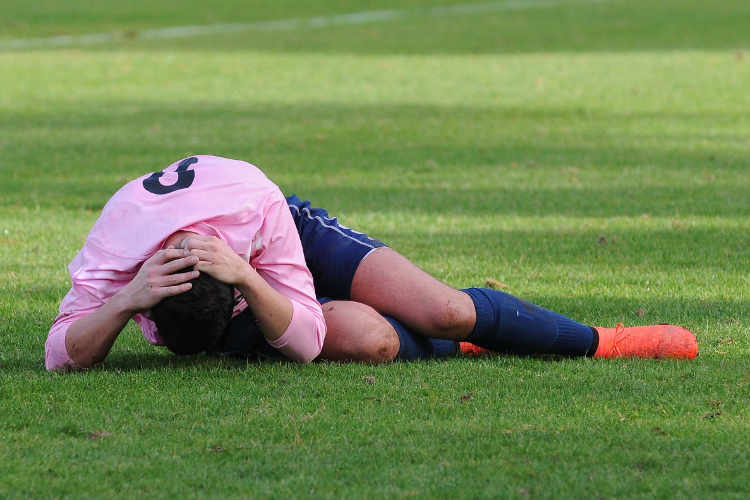
An on-field sporting injury to the head or neck can potentially be very serious and such injuries need to be managed effectively and safely. If a player is unconscious or cannot move, the most important aspects of treatment are spinal precautions and resuscitation. Assessment and treatment of these injuries is best performed by medical personnel.
Emergency procedures for head and neck sports injuries
- Call 000 for an ambulance immediately.
- Check that the player is not at risk of further injury and whether they are responding to stimuli (e.g. talking, responding to pain). Check the player’s breathing and pulse without moving their head or neck.
- If the player is not breathing and has no pulse, begin cardiopulmonary resuscitation (CPR). CPR involves mouth-to-mouth breathing and external heart massage through the chest.
- If the player is breathing but not moving, DO NOT MOVE the person. The player can only be moved when a spinal injury has been ruled out by medical personnel.
Concussion
Concussion is a temporary loss of awareness or consciousness caused by a blow to the head.
- The symptoms of a concussive head injury may include headaches, blurred vision, dizziness, nausea and loss of consciousness.
- The player should be taken off the field and should be monitored closely.
- If the player experiences persistent vomiting or complains of an increasingly painful headache they should be transported to hospital immediately.
- If the player is unconscious for more than one minute or if they experience a seizure or fit, they should be transported to hospital immediately.
- If medical personnel are not at the field to assess the player, they should be transported to hospital for further assessment and medical attention. The player should not return to play unless they have been assessed by medical personnel.
- Return to sports and activity after a head injury should be in a graded manner and under the supervision of appropriately trained medical professionals.
Facial fractures
- Facial swelling, bruising, deformity, difficulty in facial movement and pain are all signs of a broken nose, cheekbone or a mid-face fracture. The player should be taken off the field and an ice-pack should be applied to the injury to minimise swelling before the player is taken to hospital for further treatment.
- If the player cannot bite or completely close their mouth, they may have a fractured jaw bone. The player should be temporarily bandaged around the jaw and head to prevent movement before being transported to hospital.
- When a facial fracture has occurred and a cervical spine injury has been excluded by medical personnel, the player should be seated upright in a forward-leaning position to allow drainage of blood and fluids.
Eye injury
-
- Symptoms of eye injury include obscured or blurred vision, pain and non-matching pupil sizes.
- The player should be taken off the field and transported to hospital for further treatment.
- If the player has sensations of flashing lights, blackness or the sense of a curtain falling in front of the eye, they may be suffering retinal damage and should be transported to hospital immediately. In such cases, eye patches (if available) should be placed over both eyes.
