
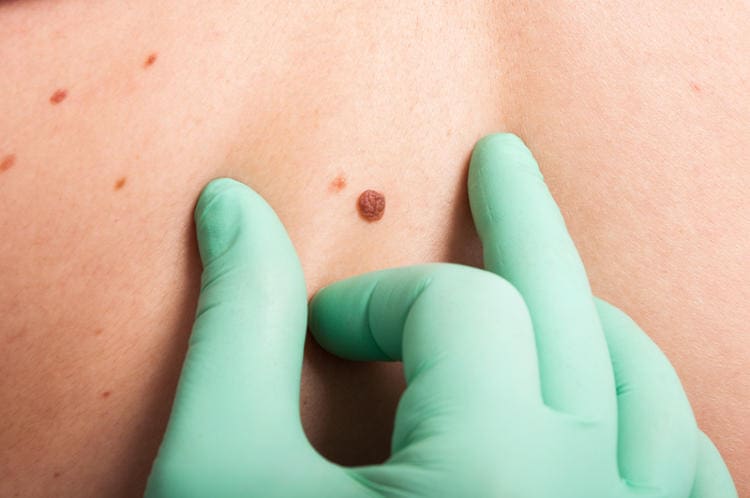
What is skin cancer?
Skin cancer is the uncontrolled growth of abnormal cells in the skin.
What types are there?
The three main types of skin cancer are basal cell carcinoma (BCC), squamous cell carcinoma (SCC) and melanoma. BCC and SCC are also called non-melanoma or keratinocytic skin cancers.
Rare types of skin cancer include Merkel cell carcinoma and angiosarcoma, but they are treated differently from BCC and SCC. Call Cancer Council 13 11 20 to find out more about rarer skin cancers.
Basal cell carcinoma (BCC)
This starts in the lower layer of the epidermis. It makes up about 70% of non-melanoma skin cancers.
BCC grows slowly over months or years and rarely spreads to other parts of the body. The earlier a BCC is diagnosed, the easier it is to treat. If left untreated it can grow deeper into the skin and damage nearby tissue, making treatment more difficult.
Having one BCC increases the risk of getting another. It is possible to have more than one BCC at the same time on different parts of the body.
Squamous cell carcinoma
This starts in the upper layer of the epidermis. It accounts for about 30% of non-melanoma skin cancers.
SCC may spread to other parts of the body if left untreated. SCC on the lips and ears is more likely to spread and should be examined by a doctor as soon as possible.
Squamous cell carcinoma in situ, or Bowen disease, is an early form of skin cancer that begins in the top layer of the skin (epidermis). It looks like a red, scaly patch and can develop into invasive squamous cell carcinoma if left untreated. The diagnosis and treatment of squamous cell carcinoma in situ is similar to BCC and SCC.
Melanoma
This starts in the melanocyte cells of the skin. Although it is not as common as BCC and SCC, melanoma is considered the most serious type of skin cancer. This is because it is more likely to spread to other parts of the body, such as the lymph nodes, lungs, liver, brain and bones, especially if not detected early.
Australia and New Zealand have the highest rates of melanoma in the world.
For more information, call Cancer Council 13 11 20 and request a copy of Understanding Melanoma, or download a copy from your local Cancer Council website. The Melanoma Institute Australia website at melanoma.org.au also has more details.
Making treatment decisions
Skin cancers may be treated by GPs, dermatologists and surgeons.
- Before you see the doctor, it may help to write down any questions you’d like to ask – see the list of suggested questions below.
- Many people like to take a relative or friend with them to the doctor to take part in the discussion, take notes or simply listen.
- Be guided by your doctor and weigh up the advantages and disadvantages of different treatments. If only one type of treatment is recommended, ask your doctor why you have not been offered other choices.
- If you have a partner, you may want to discuss the treatment options together. Talking to friends and family, or to other people who have had similar experiences, may also be helpful. Call Cancer Council 13 11 20 to find out ways to connect with others for mutual support.
- You have the right to accept or refuse any treatment offered by your doctors and other health professionals.
To find a dermatologist or surgeon, visit the Australasian College of Dermatologists website at dermcoll.edu.au and use the “Find a dermatologist” search bar.
Questions checklist
You may find this checklist helpful when thinking about the questions you want to ask your doctor about the skin cancer and treatment. If your doctor gives you answers that you don’t understand, ask for clarification.
- What is this spot on my skin?
- Will I need a biopsy?
- What is my biopsy result? Do I have skin cancer?
- What type of skin cancer is it?
- Did the biopsy remove all of the skin cancer?
- Do I need further treatment? If so, what treatment do you recommend?
- Do I need to see a specialist?
- What will happen if I don’t have treatment?
- How much will the treatment cost?
- Will there be any scarring after the skin cancer has been removed?
- When will I get my results and who will tell me?
- Is this skin cancer likely to come back?
- How often should I get my skin checked?
- Where can I go for follow-up skin checks?
- Will I need any further tests after treatment is finished?
A second opinion
You may want to get a second opinion from another doctor to confirm or clarify your doctor’s recommendations, or to reassure you that you have explored all of your options. Doctors are used to people doing this.
Your doctor can refer you to another doctor and send your initial results to that person. You can get a second opinion even if you have started treatment or still want to be treated by your first doctor. You might decide you would prefer to be treated by the doctor who provided the second opinion.
Taking part in a clinical trial
Your doctor or nurse may suggest you take part in a clinical trial, though this is not common for skin cancers. Doctors run clinical trials to test new or modified treatments and ways of diagnosing disease to see if they are better than current methods. For example, if you join a randomised trial for a new treatment, you will be chosen at random to receive either the best existing treatment or the modified new treatment.
Over the years, trials have improved treatments and led to better outcomes for people diagnosed with cancer. It may be helpful to talk to your specialist or clinical trials nurse, or to get a second opinion. If you decide to take part, you can withdraw at any time. For more information, call Cancer Council 13 11 20 for a free copy of Understanding Clinical Trials and Research, or visit australiancancertrials.gov.au.
Treatment
Skin cancer is treated in different ways. Treatment depends on:
- the type, size and location of the cancer
- your general health
- any medicines you are taking (these can affect the amount of bleeding and the healing time)
- whether the cancer has spread to other parts of your body.
If the biopsy has removed all the cancer (see Skin biopsy, page 18), you may not need any further treatment.
Many of the treatments described in this chapter are suitable for sunspots as well as skin cancers.
Surgery
Surgery is the most common treatment for skin cancer. It is usually a quick and simple procedure that can be performed by a GP or a dermatologist. More complex cases may be treated by a surgeon.
The doctor uses a local anaesthetic to numb the affected area, then cuts out the skin cancer and some nearby normal-looking tissue (margin) before closing the wound with stitches. A pathologist checks the margin to make sure the cancer has been completely removed. The results will be available in about a week. If cancer cells are found in the margin, further surgery may be required.
Repairing the wound
For large skin cancers, a bigger area of skin needs to be removed, and the wound is covered with a skin flap or skin graft.
For a skin flap, nearby loose skin or fatty tissue is moved over the wound and stitched. For a skin graft, a thin piece of skin from another part of the body is stitched over the wound. These procedures may be performed in the doctor’s office but are sometimes done as day surgery in hospital under a local or general anaesthetic.
Mohs surgery
Mohs surgery, or microscopically controlled excision, is usually done under local anaesthetic by a dermatologist to treat large skin cancers that have penetrated deep into the skin or come back (recurred). It can also be used for cancers in areas that are difficult to treat, such as near the eye or on the nose, lips and ears.
This procedure is done in stages. The doctor removes the cancer little by little and checks each section of tissue under a microscope. They keep removing tissue until they see only healthy tissue under the microscope, and then close the wound with stitches or, sometimes, a skin flap or graft.
Mohs surgery reduces the amount of healthy skin that is removed while making sure all the cancer is taken out.
Mohs surgery is available only at some private specialist dermatology practices and private hospitals. The procedure costs more than other types of skin cancer surgery because of the time it takes and the equipment required.
Curettage and cautery
Curettage and cautery is used to treat some BCCs and squamous cell carcinoma in situ. It is usually done by a dermatologist.
You will be given a local anaesthetic and the doctor will scoop out the cancer using a small, sharp, spoon-shaped instrument called a curette. They will then apply low-level heat (cautery) to stop the bleeding and destroy any remaining cancer, and cover the wound with a dressing. The wound should heal within a few weeks, leaving a small, flat, round, white scar.
Cryotherapy
Cryotherapy, or cryosurgery, is a freezing technique used to remove sunspots and some superficial BCCs.
The doctor, usually a dermatologist, sprays liquid nitrogen onto the sunspot or skin cancer and a small area of skin around it. This causes a burning or stinging sensation, which lasts a few minutes. The liquid nitrogen freezes and kills the abnormal skin cells and creates a wound, which will be sore and red for a few days and may weep or blister. The area may also swell for a few days. In some cases, the procedure may need to be repeated.
A crust will form on the wound and the dead tissue will fall off after 1–4 weeks, depending on the area treated. New, healthy skin cells will grow and a scar may develop. Healing can take a few weeks, and the healed skin will probably look paler and whiter than the surrounding skin.
Topical treatments
Some skin spots and cancers can be treated using creams or gels prescribed by a doctor that you apply directly on the skin. These are called topical treatments. They may contain immunotherapy or chemotherapy drugs as their active ingredient.
Immunotherapy
Sunspots, superficial BCCs and squamous cell carcinoma in situ (Bowen disease) can be treated using a cream called imiquimod (brand name, Aldara). This is a type of immunotherapy drug that causes the body’s immune system to destroy the cancer cells. You apply imiquimod directly to the affected area once a day at night, usually five days a week for six weeks.
Imiquimod can cause scabbing and crusting, which may be uncomfortable. The treated skin may become red and inflamed and may be tender to touch. Some people have a more serious reaction to imiquimod, but this is uncommon. Symptoms include pain or itching in the affected area, fever, achy joints, headache and a rash. If you experience any of these more serious side effects, stop using the cream and see your doctor immediately.
Chemotherapy 5-fluorouracil (5-FU)
This cream is used to treat superficial BCCs, sunspots and, sometimes, squamous cell carcinoma in situ (Bowen disease). It works best on the face and scalp. Your GP or dermatologist will explain how to apply the cream and how often. Many people use it twice a day for three to four weeks.
While using the cream, you will be more sensitive to the sun and will need to stay out of the sun. The treated skin may become red, blister, peel and crack, and often feel uncomfortable. These effects will usually settle within a few weeks after treatment has finished.
Ingenol mebutate
This new type of topical chemotherapy for sunspots is a gel that you apply to the affected skin once a day for two or three days. Side effects can include skin reddening, flaking or scaling, mild swelling, crusting or scabbing, and blisters. These side effects should disappear within a couple of weeks after treatment has finished.
Vismodegib
A new treatment for people with BCC that has spread and who aren’t suitable for surgery and radiation therapy. It is taken as a tablet once a day. Common side effects include muscle spasms, taste changes and upset stomach.
Photodynamic therapy
Photodynamic therapy (PDT) uses a cream and a light source to treat sunspots, superficial BCCs and squamous cell carcinoma in situ (Bowen disease).
The GP or dermatologist gently scrapes the area with a curette and applies a cream that is sensitive to light. After three hours, they will shine a special light onto the area for about 8 minutes and cover it with a bandage. For skin cancers, PDT is usually repeated after two weeks.
Side effects can include redness and swelling, which usually ease after a few days. Some people experience a burning or stinging sensation during PDT, particularly for treatment to the face. Your doctor may use a cold water spray or pack, or give you a local anaesthetic to help ease the discomfort.
Radiation therapy
Radiation therapy (also called radiotherapy) uses radiation such as x-rays or electron beams to damage or kill cancer cells. It is used for BCC or SCC in areas that are difficult to treat with surgery, such as the face, and for cancers that have spread or come back.
You will lie on a table while the radiation therapy machine is positioned around you. This can take 10–30 minutes, but the treatment itself will take only a few minutes. Radiation therapy is usually given five times a week for several weeks. Skin in the treatment area may become red and sore 2–3 weeks after treatment starts and may last for a few weeks after treatment has finished. For more information, call Cancer Council 13 11 20 and ask for a free copy of Understanding Radiation Therapy, or download a copy from your local Cancer Council website.
Removing lymph nodes
If the cancer has spread, the doctor may recommend a lymph node dissection. This means that the cancerous lymph nodes are cut out to reduce the chance of the cancer spreading to other parts of the body or coming back. For more information, speak to your doctor.
Key points
- Surgery is the most common and successful treatment for skin cancer.
- During surgery, your doctor will carefully cut out the skin cancer and close the wound with stitches. Sometimes the doctor will use skin from another part of the body (flap or graft) to cover the wound.
- Mohs surgery, also known as microscopically controlled excision, is a specialised procedure that is only available at some private clinics and private hospitals. The surgeon removes layers of cells and checks them under a microscope immediately. The aim is to remove the cancer cells and leave only healthy tissue.
- Curettage and cautery is when the doctor gently removes the cancer with a sharp tool called a curette. Then low-level heat (cautery) is used to stop the bleeding and destroy any remaining cancer cells.
- Cryotherapy is used to treat sunspots and some skin cancers. The doctor will spray liquid nitrogen onto the skin to freeze and destroy the cancer cells.
- Some skin spots and cancers can be treated using creams, lotions and gels. This is called topical treatment and it includes immunotherapy, 5-FU chemotherapy, ingenol mebutate and vismodegib.
- Photodynamic therapy is the use of a light source and a cream to treat sunspots and some skin cancers.
- Cancers that are hard to treat with surgery may require treatment with radiation therapy.
Looking after yourself
Will I get other skin cancers?
After treatment, you will need regular check-ups to confirm the cancer hasn’t come back. People who have had skin cancer are also at higher risk of developing more skin cancers. This is because sun damage builds up over time and cannot be reversed.
It’s important to prevent further damage to your skin. Follow the steps under Protecting your skin from the sun to make sun protection a part of your lifestyle, and visit your doctor for yearly full body skin checks.
Sun exposure and vitamin D
UV radiation from the sun causes skin cancer, but it is also the best natural source of vitamin D, which is needed to develop and maintain strong and healthy bones.
The amount of sunlight you need for vitamin D depends on several factors, including the UV level, your skin type and your lifestyle. UV levels vary across Australia, so the time you need to spend in the sun will be determined by your location, the season and time of day, cloud coverage and the environment. (For more information on the UV Index, see below.)
The body can only absorb a limited amount of vitamin D at a time. Getting more sun than recommended does not increase your vitamin D levels, but it does increase your skin cancer risk. For most people, just 15–20 minutes of incidental sun exposure, such as walking from the office to get lunch or hanging out the washing, is enough to produce the required vitamin D levels.
After a diagnosis of skin cancer, talk to your doctor about the best ways to maintain vitamin D while reducing your risk of further skin cancers.
The UV Index and sun protection times
The UV Index shows the intensity of the sun’s UV radiation using a scale that begins at 0 and has no upper limit. An index of 3 or above indicates that UV levels are high enough to damage skin and sun protection is recommended.
The daily sun protection times tell you the times of day the UV Index levels are forecast to be 3 or higher. The sun protection times vary according to your location and will change throughout the year. In general, during summer in Australia, all states experience long periods during the day when the UV Index is 3 or above. In late autumn and winter in southern Australia, the UV Index may fall below 3 and sun protection is not necessary.
You can check the sun protection times on the weather page of Australian daily newspapers, the Bureau of Meteorology website at bom.gov.au or by downloading the free SunSmart app for iPhone, iPad and Android devices.
After having a BCC cut out, I was more conscious of using sunscreen and wearing a hat. I found using the SunSmart app a good way to know when to avoid being outside. Pete
Protecting your skin from the sun
When UV levels are 3 or above, use a combination of measures to protect your skin
Slip on clothing
Wear clothing that covers your shoulders, neck, arms, legs and body. Choose closely woven fabric or fabric with a high ultraviolet protection factor rating.
Slop on sunscreen
Use an SPF 30+ or higher broad-spectrum sunscreen. Use a water resistant product for sports and swimming. Apply a generous amount of sunscreen 20 minutes before going out and reapply every two hours, or after swimming or any activity that causes you to sweat or rub it off.
Slap on a hat
Wear a broad-brimmed hat that shades your face, neck and ears. Adult hats should have at least a 7.5 cm brim. Hats for children aged under 8 years should have at least a 5 cm brim, and hats for children aged 8–12 should have at least a 6 cm brim.
Avoid sun lamps and solariums
Do not use sun lamps, solariums or tanning beds (banned for commercial use), which give off UV radiation.
Seek shade Use
shade from trees, umbrellas, buildings or any type of canopy. UV radiation is reflective and bounces off surfaces, such as concrete, water, sand and snow. If you can see the sky, even if the direct sun is blocked, the shade will not completely protect you from UV.
Protect children
Use a combination of sun protection measures to protect babies and children from direct sunlight. Applying sunscreen on babies under 6 months is not recommended
Slide on sunglasses
Protect your eyes with sunglasses that meet the Australian Standard AS1067. Wraparound styles are best. Sunglasses should be worn all year round.
Check sun protection times every day
Use the SunSmart UV Alert to check daily sun protection times in your local area. It is available as a free SunSmart app, online (sunsmart.com.au or bom.gov.au/uv), in the weather section of daily newspapers, or as a free website widget.
Seeking support
Cosmetic care
Skin cancer treatments such as surgery, curettage and cautery, and cryotherapy often leave scars. In most cases, your doctor will do everything they can to make the scar less noticeable. Most scars will fade with time.
You may worry about how the scar looks, especially if it’s on your face. Various cosmetics are available to help conceal scarring. Your hairstyle or clothing might also cover the scar. You may want to talk to a counsellor, friend or family member about how you are feeling after any changes to your appearance.
Look Good Feel Better
Look Good Feel Better is a national program that helps people manage the appearance-related effects of cancer treatment. Workshops are run for men, women and teenagers. For information about services in your area, visit lgfb.org.au or call 1800 650 960.
Practical and financial help
Skin cancer may cause practical and financial difficulties, particularly for people who have to travel for treatment.
Financial assistance – through benefits, pensions and programs – may help pay for prescription medicines and transport costs to medical appointments. These services may be different in each state and territory. For information about services in your local area and whether you are eligible to receive them, call Cancer Council 13 11 20 or, if you are treated in hospital, ask the social worker.
