
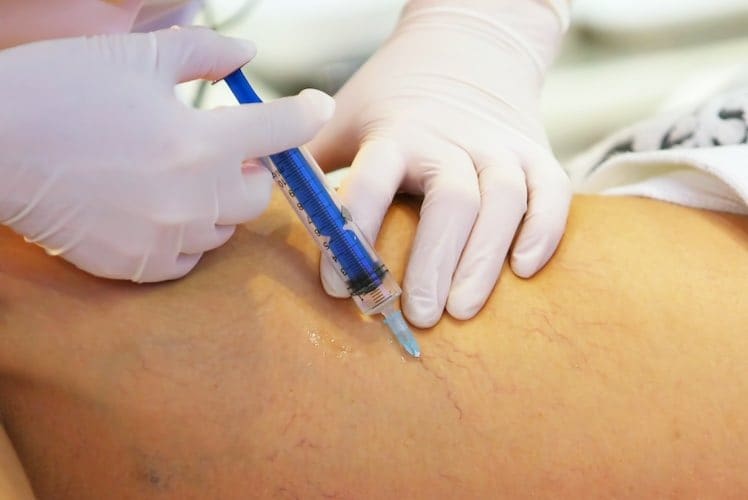
Sclerotherapy is a treatment that involves the injection of a chemical solution into blood vessels, usually spider veins or varicose veins on the legs.
Sclerotherapy irritates the vessel walls, making them stick together. This leads to fibrosis, or scarring, of the blood vessel. The vessel then becomes unable to carry blood and starts to shrink, making it less visible under the skin. Eventually the blood vessel should disappear altogether.
Doctors describe a vein that has been obliterated in this way as ‘sclerosed’.
What is sclerotherapy used for?
Sclerotherapy is most commonly used for the treatment of unwanted, visible spider veins and superficial (surface) varicose veins.
Spider veins
Spider veins (thread veins) are tiny red or blue veins that can appear anywhere on the body but occur most commonly on the legs. Sclerotherapy is often used to treat spider veins on the legs.
Varicose veins
Varicose veins are generally larger veins that can be raised above the skin’s surface. Varicose veins can sometimes cause aching legs and swelling of the ankles. They can also be associated with burning, stinging, throbbing, restless legs and leg cramps.
Not all varicose veins are suitable for sclerotherapy — if the varicose veins are large or if the valves in the veins are very leaky, surgery may be a better option than sclerotherapy. Your doctor may suggest an ultrasound to see whether your veins are suitable for sclerotherapy.
What happens when you have sclerotherapy?
Your doctor will use very fine needles to inject a sclerosing solution into the problem blood vessels. In some cases, your doctor will use ultrasound to guide the needle. Various types of sclerosing solutions can be injected into the veins.
Tiny amounts of liquid sclerosant are usually used to treat spider veins and small varicose veins. Larger varicose veins may be treated with foam sclerotherapy, where a foam sclerosant (made up of standard sclerosant mixed with air or carbon dioxide) is used. This may be done under ultrasound to ensure that the injection is given in the right place.
Is sclerotherapy painful?
Sclerotherapy injections usually cause minimal discomfort. It has been described as feeling like small pin pricks. Some people might experience a slight to moderate burning sensation immediately after the injection.
There may also be a cramping sensation as the sclerosant is injected into larger varicose veins. This should last only a minute or two.
Anaesthetic is not usually needed for sclerotherapy, which can be done in your doctor’s consulting rooms.
How long does sclerotherapy take?
A treatment session takes about 30 to 45 minutes. Multiple veins can be injected during one treatment session.
Your veins may require a number of repeat injections over a period of weeks or months to ensure they are fully sclerosed and fade from view.
What are the side effects of sclerotherapy?
Following injection sclerotherapy there are often raised, red areas at the injection sites. These usually resolve within the hour. People may also notice bruising, which may last a couple of weeks.
Sometimes a sclerosed vein will temporarily become hard and lumpy straight after treatment, but this should get better quickly. Temporary aching in the legs can also occur – this can be helped by walking and by taking painkillers such as paracetamol if necessary.
More serious complications
Other more serious but rare side effects of sclerotherapy include the following.
- Infection where the injection was given.
- Brown staining of the skin at the site of the injection and sometimes along the line of the vein. This is caused by haemosiderin (an iron storage protein) from blood being trapped in the injected vessel. It usually clears up but may take up to a year to disappear completely.
- Ulcers or blisters on the skin, which usually means the sclerosant has mistakenly been injected into the tissue surrounding the vein, rather than into the vein.
- An allergic reaction to the sclerosing solution.
- Blood clots developing in the deep veins of the leg – deep venous thrombosis. Doctors generally advise that you walk for at least 30 minutes a day for several days after sclerotherapy to reduce the risk of blood clots developing.
Long-term side effects of sclerotherapy are unusual.
Recovery from sclerotherapy
Recovery from sclerotherapy is usually quick. While you may have some bruising for a week or so afterwards, there is usually very little pain. In terms of appearance, it may take several weeks to see the final results for spider veins, and a few months for varicose veins.
It’s very important that you wear specially-fitted compression stockings for a couple of weeks after sclerotherapy treatment. This is important to ensure that the walls of the veins stick together.
Doctors usually recommend you walk for about half an hour each day after having sclerotherapy. It’s also important that you don’t stand still for long periods. When sitting, elevate your legs so that your ankles are higher than your hips.
Will my veins come back after sclerotherapy?
Veins that have been adequately treated with sclerotherapy will not recur. However, new vessels may appear over time.
Wearing support stockings, keeping your weight under control and exercising are thought to be helpful in preventing the development of new vessel abnormalities, in particular varicose veins.
Where can I get sclerotherapy?
If you have visible veins and think sclerotherapy may help you, talk to your general practitioner (GP) who may refer you to a specialist doctor for sclerotherapy if appropriate. Depending on the type of veins that are being treated, sclerotherapy can be done by surgeons, dermatologists (skin specialists) or phlebologists (vein specialists).


