
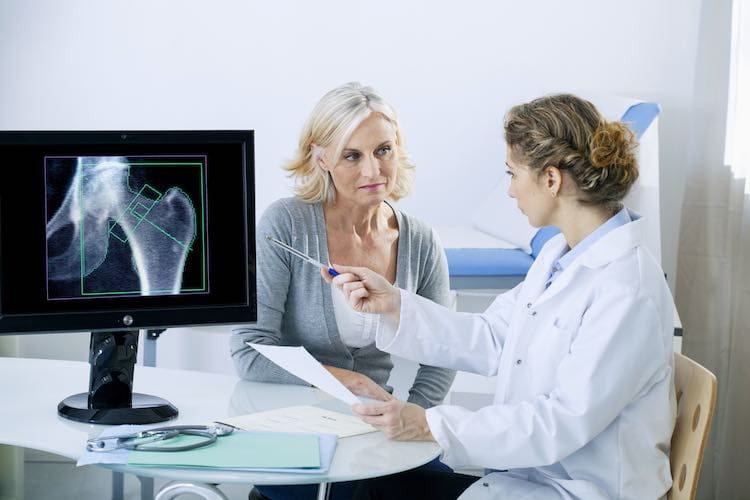
Osteoporosis is a condition that affects bones, making them less dense, more fragile and prone to fractures.
Some people have a higher risk of developing osteoporosis than others. Also, certain bones in the body are more likely than others to become weakened by osteoporosis and fracture. (A fracture is a complete or partial break in a bone).
Bones and osteoporosis
Your bones have 2 types of structure: a dense form called cortical bone and a lattice-like form called spongy bone (also known as cancellous or trabecular bone).
- Cortical bone forms the hard outside layer of all bones in the body and makes up most of the skull and ribs.
- Spongy bone is mainly found inside the vertebrae (the bony segments of the spinal column), and inside the ends of long bones like the femur (thigh bone).

In a normal thigh bone, there is cortical bone along the outside of the shaft of the bone, and spongy bone inside the end of the bone, near the hip joint.

With osteoporosis, there is reduced bone density and structure in the spongy bone, as well as thinning of the cortical bone.
When your bones have thinned to the point that osteoporosis is diagnosed, the physical structure — and soundness — of your bones has changed. In particular:
- the cortical bone becomes thinner; and
- the spongy bone becomes less dense with bigger spaces forming between the bony structure of struts, which also become thinner.
Osteoporosis and fractures
Osteoporotic changes can mean your bones become thin and brittle, and are more likely to have a fracture.
Common sites for a fracture because of osteoporosis include:
- the thigh bone (femur) at the hip;
- the vertebrae of the spine; and
- the wrist.

People with osteoporosis can have a fracture because of a minor fall or light bump.
A fracture in the spine can occur because of compression of the weakened bone, which in osteoporosis can happen during the simple motion of bending forward or lifting. This type of fracture in the spine can lead to pain and a marked curving of the spine with an associated loss of height that can be seen in older people with osteoporosis.
A fracture of the thigh bone at the hip due to a fall can lead to an inability to walk unassisted for a prolonged period, a loss of independence, long-term nursing care and an increased likelihood of dying during the year following the fracture.
But there are steps you can take to help reduce your chances of getting osteoporosis, and for those who have osteoporosis there are treatments available that help strengthen bones and reduce the risk of fractures.
Bone health and what affects it
Bone is a living tissue that is in a state of constant turnover. Spongy bone turns over faster than cortical bone.
Cells within the bone include:
- osteoblasts, which are involved in forming new bone; and
- osteoclasts, which resorb (break down) bone. (When bone is resorbed calcium and other minerals are removed from bone tissue and released into the circulation.)
Both osteoblast activity and osteoclast activity are needed to maintain healthy bone tissue. The balance between these 2 opposing activities within bone is influenced by several factors, including:
- your age;
- your genes;
- the amount of certain hormones (such as sex hormones oestrogen and testosterone) in your body;
- the amount of physical activity you get (exercise increases osteoblasts to strengthen bones); and
- the amount of calcium and vitamin D in your body.
Age and your bones
Osteoporosis is most common in people older than 50 years of age.
If the amount of bone being formed is greater than the amount of bone being resorbed, then your bone mass — the amount of bone in your skeleton — will increase, as occurs during childhood. However, around the age of 30, the amount of bone being resorbed begins to become slightly greater than the amount of bone being formed, and for many years after this age, this slight imbalance leads to a gradual loss of bone mass as you age.
Menopause and bones
If you are a woman, the menopause is a significant event in terms of your bones. The drop in the level of the female hormone oestrogen causes a marked decrease in bone mass after the menopause.
Can men get osteoporosis?
Bone density in men does decrease with age, but it tends to decrease more slowly than in women. Although osteoporosis is more common in women, men can also develop osteoporosis.
Men who have a lower than normal testosterone level have an increased risk of developing osteoporosis.
Additional risk factors for osteoporosis
Along with increasing age and being female and having been through menopause, other risk factors for osteoporosis include:
- a family history of osteoporosis;
- having previously had bone fractures after minor falls;
- height loss of 3cm or more as you have aged;
- being under- or overweight (your risk of osteoporosis is increased if you have a thin build or are obese);
- low intake of calcium;
- low vitamin D levels;
- lack of weight-bearing physical activity;
- being a smoker;
- drinking excessive amounts of alcohol;
- other medical conditions, such as thyroid problems, coeliac disease, rheumatoid arthritis or chronic (ongoing) liver or kidney disease; and
- taking certain medicines, such as corticosteroids.
Helping to prevent osteoporosis
Osteoporosis can go unnoticed for many years unless a fracture occurs. It is therefore important to discuss your bone health with your doctor as you get older, even if you have not experienced a fracture.
To help enhance bone formation, all people — especially women who have gone through menopause — should:
- do regular weight-bearing exercise such as walking;
- eat a diet that contains enough calcium — usually by eating dairy foods, tinned salmon or sardines (with bones) and leafy green vegetables such as cabbage, kale and broccoli — regularly. The recommended amount of calcium for men and women is 1000 mg per day; women older than 50 years and men older than 70 need at least 1300 mg every day;
- get some exposure to sunshine each day or take a vitamin D supplement (vitamin D levels can be measured if your doctor think you are at risk of deficiency);
- avoid smoking;
- avoid drinking alcohol excessively; and
- ask their doctor about their bone health as they get older.
