
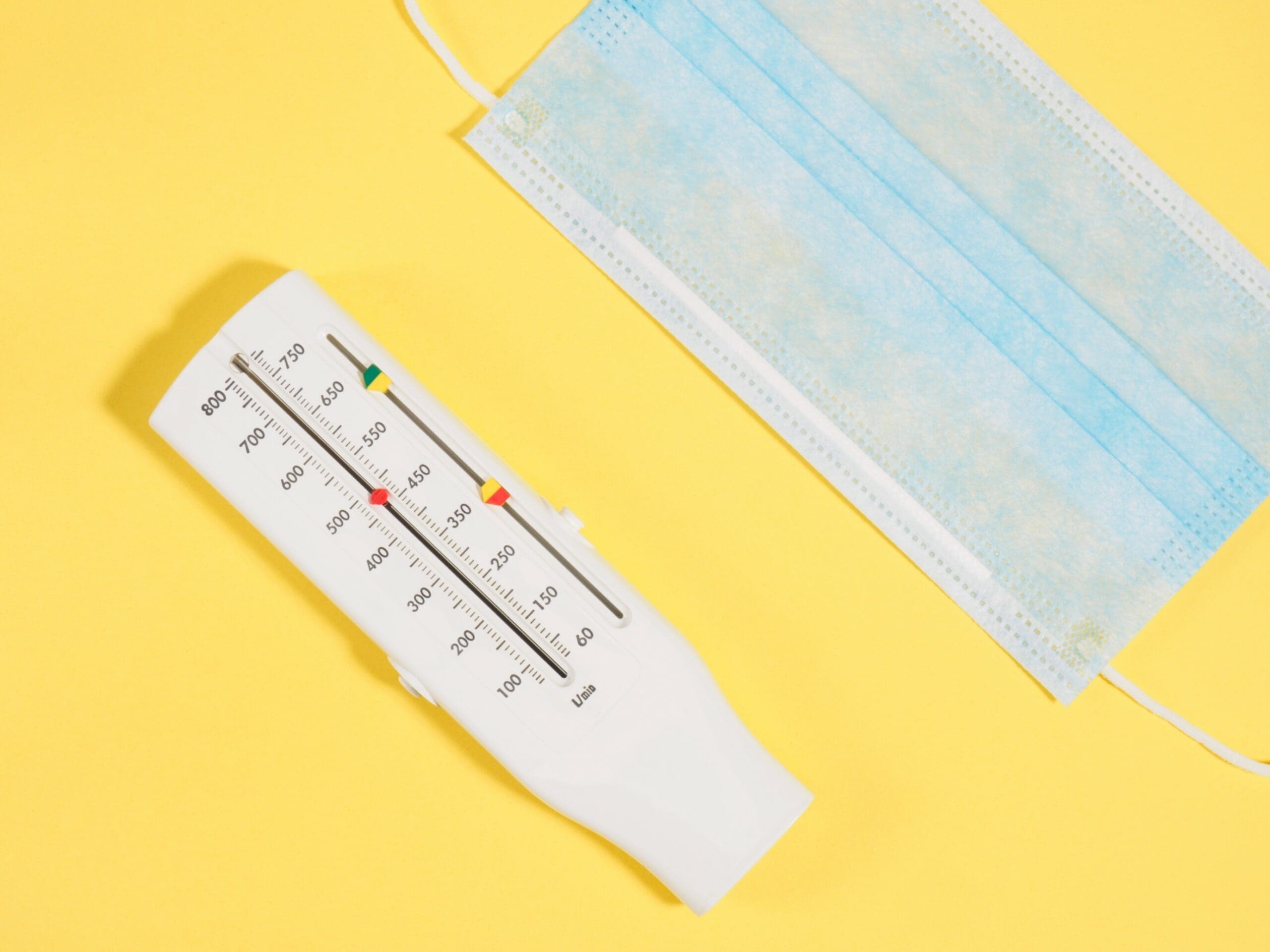
Some people with asthma use a peak flow meter to help manage their asthma. However, peak flow measuring may not be for everyone — for example, it is often not suitable for young children. Your doctor will advise you if using a peak flow meter should be part of your ongoing asthma management plan.
What is a peak flow meter?
A peak flow meter is a simple hand-held device that you can use at home to keep track of your asthma by measuring your lung function.
A peak flow meter measures how fast you can blow air out of your lungs. As your airways narrow with asthma, the resistance to air flow increases dramatically — the lower the reading is, the greater the narrowing of your airways. The reading on the meter is called your peak expiratory flow (PEF) or ‘peak flow’, and is measured in litres per minute.
Changes in your peak flow, compared to your best ever recorded (‘personal best’) peak flow, show changes in your asthma control: the lower your peak flow compared to your personal best peak flow, the more your airways are narrowed.
Finding out your peak flow rate
Your doctor can read from a chart an expected peak flow rate for someone of your height, age and sex. More importantly, however, your doctor will want to find out the best possible peak flow that you can manage — your personal best peak flow — which will probably be different from an expected peak flow rate.
To do this, your doctor may ask you to measure your peak flow rate at home, in the morning and the evening, over one or more weeks. By writing down your peak flow on a chart as you go, you will have a set of readings that allows your doctor to work out your current personal best peak flow — a key part of your asthma action plan.
Your doctor may also use these readings to:
- understand your asthma before deciding on your long-term asthma treatment; and/or
- find out how you respond to asthma medicines by asking you to record your peak flow both before and after taking your medicines.
In the week or so before any appointment with your doctor, it’s always a good idea to record your peak flow morning and evening, at the same times every day.
Continuing to check your peak flow rate
Regularly checking your peak flow at home (usually on first waking and again in the evening) and recording it on a chart or graph, along with writing down your symptoms in a diary, forms the basis of your asthma action plan. Your doctor will help you decide whether you need to do this every day.
It is especially important to check your peak flow when you are:
- changing medicines;
- having asthma symptoms that are worse or more frequent than usual;
- exposed to your asthma triggers;
- not feeling as well as usual; and
- more likely to have worsening of your asthma symptoms, which often happens when you feel a cold coming on, or have a major change like starting a new job or going on holidays.
Your asthma action plan
When your asthma control is worsening, often your peak flow will fall below your personal best peak flow before your usual asthma symptoms appear. In this way, keeping a check on your peak flow rate can help you pick up changes in your asthma control and give early warning of a possible impending asthma attack. Then, by following your doctor’s instructions on your asthma action plan — about how to increase your medicine and when to see your doctor — you should keep well, and have less chance of having a serious asthma attack.
If your peak flow is below 80 per cent of your personal best peak flow, and if your morning and evening peak flow scores differ by more than 15 per cent (assuming you are an adult), then your asthma is not being well controlled, and you need to adjust your medicine and see your doctor to help get back on track.
Keeping peak flow measurements useful
For peak flow measurements to be useful, you must always:
- use the same peak flow meter;
- take regular readings at the same time each day rather than one-off readings;
- use the same effort when blowing into the meter; and
- use the correct technique.
If you don’t follow these measures, your peak flow scores may be unreliable, and could lead to you using the wrong amount of medicine, and your asthma being poorly controlled.
Children under 7 years old can’t always use a peak flow meter reliably, so doctors will usually recommend that their asthma be checked at home by watching and recording their asthma symptoms, rather than their peak flow.
Correct technique for using your peak flow meter
Ask your doctor or pharmacist to regularly check your technique for using your peak flow meter.
Here are some pointers to the correct use of your peak flow meter.
- Attach the mouthpiece to the end of the peak flow meter.
- Put the marker to zero.
- Take in a big breath — make sure you are standing up straight.
- Place your lips tightly around the mouthpiece — keep the peak flow meter horizontal (i.e. level with the floor) while carrying out the test.
- Blow into the meter as hard and as fast as you can for 2 to 3 seconds to empty your lungs (do not spit or cough into the meter).
- Read your score on the meter.
- Put the marker back to zero.
- Repeat the measurement 2 more times.
- Record only the best of the 3 readings as your peak flow rate in your peak flow chart.
Make sure you keep your peak flow meter clean by washing it in warm soapy water every fortnight, rinsing with clean water and allowing it to dry naturally.
