
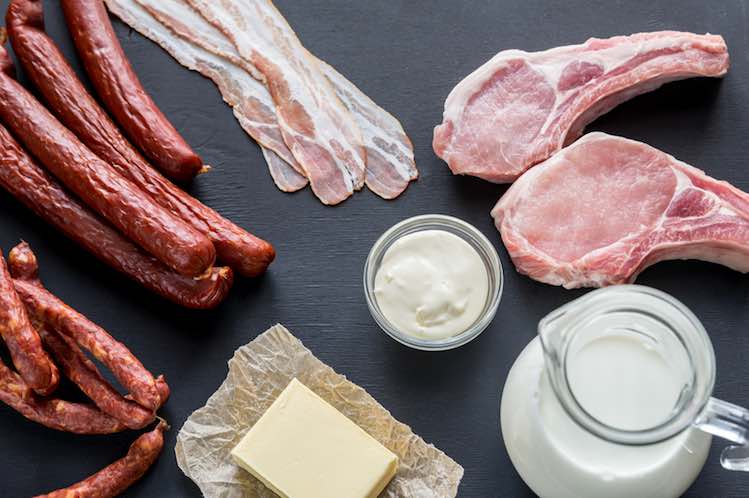
Most people know that reducing dietary fat intake is often an important step in losing weight, but not everyone knows that some types of fat are worse for your health than others. The main types of fat in foods can be categorised as:
- saturated fat;
- polyunsaturated fat;
- monounsaturated fat; and
- trans fats.
What is saturated fat?
Saturated fats are made up of different saturated fatty acids, many of which can be bad for your health. Saturated fats are usually solid or waxy at room temperature — think butter, coconut oil and the fat on meat.
Why is saturated fat bad?
Too much of any type of fat can cause weight gain, but some saturated fatty acids can also increase your cholesterol level and put you at increased risk of heart disease. In fact, saturated fats are the main dietary cause of high blood cholesterol.
Trans fats are unsaturated fats, but they can behave like saturated fats. Like saturated fat, one particular type of trans fat raises LDL (‘bad’) cholesterol, but even worse it also lowers HDL (‘good’) cholesterol. The particular type of trans fat was once common in margarines and commercial frying fats. In Australia, margarines sold as monounsaturated or polyunsaturated spreads now contain very little, if any, trans fat, although this nasty type of fat may still be found in some cooking margarines and fats used for commercial frying. Other sources include some commercially baked goods (such as cakes, chips and crackers).
Which foods contain saturated fat?
- Saturated fat is found naturally in foods from animal sources, such as red meat, poultry fat, butter, cream, cheese, milk and yoghurt.
- A few plant oils are high in saturated fat – these include palm and palm kernel oils and coconut oil. One of the saturated fatty acids found in coconut oil raises LDL (‘bad’) cholesterol but also raises HDL (‘good’) cholesterol. This means that coconut oil may be less of a problem than some other foods high in saturated fat, but it doesn’t fall into the category of ‘good’ fats.
- Saturated fat is also found in many processed foods.
- Foods such as biscuits, crackers, cakes, savoury or sweet snacks and crumbed products, where a crisp texture is desired, may involve vegetable oils being subjected to an industrial process known as hydrogenation which produces crisp fried foods. This also converts the unsaturated fats in oils into saturated fats. Partial hydrogenation of vegetable oils produces trans fat. Neither partial or full hydrogenation occur during cooking in a home kitchen.
| Foods high in saturated fat |
|---|
|
How can I avoid saturated fat?
- Go easy on take-away foods and desserts, and when snacking, try to steer away from chocolates and chips (nuts are a healthier choice).
- Limit cream, butter and full-fat cheeses, and choose low-fat or reduced-fat milk or yoghurt.
- Use liquid oils in cooking and salad dressings, such as extra virgin olive, canola, or sunflower oils. This helps reduce saturated fat and increase your intake of healthier unsaturated fats. Avoid coconut oil and palm oil as these are high in saturated fat.
- When eating red meat, choose lean cuts with little or no visible fat.
- Take the skin off chicken and other poultry.
- Eat fish twice a week, because it contains omega-3 fatty acids, which may help reduce your risk of heart disease.
- The Australian National Health and Medical Research Council recommends that saturated fat and trans fat together make up no more than 10 per cent of the daily energy intake for healthy people.
How much saturated fat is in my food?
All packeted foods in Australia declare the amount of saturated fat in the nutrition information panel on the label, helping you monitor the amount of saturated fat you consume.
Other types of fat
It is important to include some fat in your diet. You need fat to keep the membranes around every body cell healthy and also to maintain healthy skin and hair, and keep your body functioning properly. Fats also help in the absorption and storage of fat-soluble vitamins in the body.
The best types of fat are those that contain unsaturated fatty acids. Some polyunsaturated fats are not only essential nutrients for your body, but they (and also monounsaturated fats) can also help to reduce your level of ‘bad’ cholesterol when eaten as part of a diet low in saturated fat. So, by replacing saturated fat with unsaturated fats, you can reduce your risk of heart disease.
Unsaturated fats can be found in liquid oils such as olive, canola, sunflower, soy, corn, sesame, rice bran, avocado or peanut oils and also in nuts, seeds, avocado and unsaturated margarine spreads. But remember, even these healthy fats are high in kilojoules, so don’t overdo it.
Controversy over saturated fat
A recent report challenged the accepted link between heart disease deaths and how much saturated fat people consumed. This has caused many people to question the wisdom of reducing their intake of foods high in saturated fat. However, further analysis has exposed problems in the report – with some studies being omitted, and also a lack of consideration of the type of foods used to replace the foods high in saturated fat. Low-fat processed products where the fat has been replaced by sugars or refined starches are not a wise choice for most people.
A heart-healthy diet reduces foods high in saturated fat, and instead chooses healthy sources of unsaturated fats, such as avocado, nuts, seeds, fish and liquid oils. A heart-healthy diet also includes plenty of vegetables, plus some fruit and wholegrain products.
