
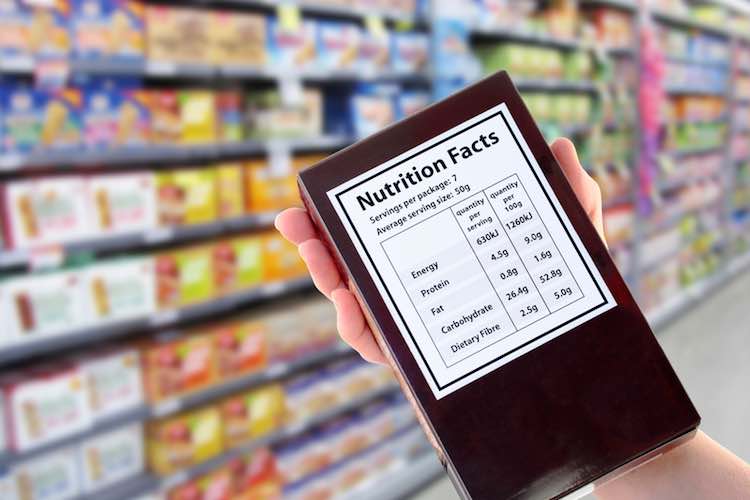
Use the nutrition information label (also called a nutrition information panel), which can be found on the packaging of almost all manufactured foods, to help you make more informed choices about the food that you eat. This one is from a box of apricot-flavoured muesli bars.
| NUTRITION INFORMATION
Servings per package: 8 |
||
| . | Quantity per serving | Quantity per 100g |
| Energy | 350 kJ | 1770 kJ |
| Protein | 1.5 g | 7.7 g |
| Fat, total | 2.1 g | 10.4 g |
| — saturated | 0.3 g | 1.4 g |
| Carbohydrates | 14.2 g | 70.8 g |
| — sugars | 4.5 g | 22.7 g |
| Sodium | 60 mg | 305 mg |
| Dietary fibre | 1.2 g | 6.0 g |
| Contains oats, wheat and soy as indicated in bold type.
Ingredients: rolled oats, sugar, puffed rice, wheat, apricot pieces (8%) [sugar, water, apricot concentrate, dextrose, colour (160(b)), vegetable gum (401), food acid (331), flavour, preservative (202)], glucose syrup, vegetable oil, tapioca starch, salt, emulsifier (soy lecithin), flavour. Product processed on a line that also processes products containing tree nuts. |
||
Nutrition Information
Energy
The nutrition label displays the quantity of energy (measured in kilojoules) found in a serving and in 100 grams (or 100 millilitres if liquid) of the product. However, there are no standards for serving sizes and they are decided by the manufacturer.
You can use the ‘quantity per serve’ information to keep track of what you’re eating, but it’s only useful if you consume the amount the manufacturer has designated as a serving. This may be easy with a muesli bar, but is likely to vary with products such as breakfast cereals, yoghurt, spreads, snacks and sauces. The serving size may also vary on different sized packs of the same product. The ‘quantity per 100 g’ information is useful if you want to compare products.
If you are trying to lose weight, you should pay particular attention to the kilojoule content on the nutrition label. Foods that are high in fat, sugar or starches tend to be high in kilojoules. Take care because some foods labelled as ‘low fat’ may contain more added sugar than the regular variety of the product. For weight loss, it’s the total kilojoule content that is important.
Saturated fat
Check the amount of saturated fat, which is listed separately from total fat. Too much of this type of fat is bad for your health — a diet that is high in saturated fat can raise your blood cholesterol level and increase your risk of heart disease.
Trans fats are another type of fat that are bad for your heart health. The particular type of trans fat in some processed foods can increase the amount of ‘bad’ cholesterol in your blood, and reduce your levels of ‘good’ cholesterol —. It can also have adverse effects on several other components of blood that increase the risk of heart disease. Some countries list the amount of trans fat in processed foods on the label. Australia only requires trans fat content to be listed where a claim is made about cholesterol, or specific types of fat, such as polyunsaturated fat or omega 3s.
Sodium
Most foods contain some natural sodium, but the majority of our sodium intake comes from salt (sodium chloride) added to processed food. Foods that are described as ‘low salt’ must have less than 120 milligrams of sodium per 100 g (or 100 mL for liquids). A food described as ‘reduced salt’ must have at least 25% less sodium than in the same quantity of a reference food. The salt content is especially important information for people with high blood pressure, because a diet low in added salt is often recommended as part of the treatment for this condition.
Other relevant nutrients
Other nutrients, such as dietary fibre, calcium, iron or particular vitamins, must also be listed on the nutrition information panel if a claim is made about them anywhere on the food packaging.
Ingredients
The ingredients are listed in descending order according to their weight at the time the product was manufactured. If water makes up more than 5 per cent of the final product, it must also be listed as an ingredient.
The amount of any key, or characterising, ingredient — such as an ingredient mentioned in the name of the product (e.g. apricots in an apricot muesli bar) — must be listed with the percentage of that ingredient in the product. An example of a characterising ingredient would be the cocoa solids in chocolate.
Additives
Natural or synthetic food additives must also be identified no matter how small the amount used, although when flavouring is used, the individual ingredients in the flavouring need not be declared. Food additives must be listed by both their class name and a number (e.g. food acid 331), so that people who are sensitive to any particular additives can avoid them. A list of food additive numbers and names is available from Food Standards Australia New Zealand.
Allergens
Any ingredient that is known to cause severe allergic reactions in some people (e.g. peanuts, tree nuts, wheat, fish and shellfish, milk, eggs, sesame seeds, soy) must be declared on the label, even if there is only a very small amount of that ingredient in the product. Sources of gluten must also be declared on food labels. A food label must also contain an advisory or warning statement if the food contains a substance that has associated health risks that people may not be aware of (e.g. the bee product, royal jelly, which can cause severe reactions in people with asthma).
Many manufacturers also voluntarily print a warning that a food ‘may contain’ traces of particular allergens, even if they are not listed in the ingredients. This is usually because those allergens are used in other products made in the same factory.
Genetically-modified (GM) foods
Any genetically modified foods or ingredients containing protein or DNA that has been altered by genetic modification must be identified on the label with the words ‘genetically modified’. In Australia, cottonseed and canola plants are often genetically modified, but their oils need not be labelled as GM because food authorities maintain that the oils do not contain protein or DNA.
Health Star Rating
A Health Star Rating system has been set up by the Australian, state and territory governments and the New Zealand Government. This ‘front-of-pack’ labelling scheme is designed to make it fast and easy for shoppers to compare packaged food and drinks on the basis of particular health risks or benefits.
Foods are assigned between half a star and 5 stars. The more stars, the healthier the product. The system started in June 2014 and companies are being encouraged to introduce it on their entire packaged food range over a 5-year period.
The stars are calculated according to the content of major food factors that increase the risk of obesity and diet-related chronic diseases (saturated fat, salt, sugars and energy content). In calculating how many stars a food product may display, fruits, vegetables, nuts and legumes, and in some instances, the protein and dietary fibre content of a food are assessed for their positive health contribution. The stars are based on 100 g (or 100 mL for liquids) so shoppers can easily compare food products both within a category and across categories. For example, if salty snack foods carry very few stars, the shopper may decide to choose a healthier product such as nuts or seeds.
Additional information
Food packaging may also display a symbol or stamp from an organisation to highlight particular nutritional information.
Foods that have a Heart Foundation ‘Tick’ on their label fit the Heart Foundation’s nutritional criteria which set limits for saturated fat and sodium and encourages manufacturers to increase dietary fibre and calcium, and to include more vegetables and wholegrain ingredients. Manufacturers have to pay to display this symbol, so there may be products that are just as good (or better) that don’t have a ‘Tick’.
Foods displaying a ‘Glycemic Index (GI) Tested’ symbol on their packaging have been evaluated for their effects on blood sugar levels. Foods that have a low glycemic (or ‘glycaemic’) index (GI) tend to raise blood sugar levels less than medium or high-GI foods, and choosing these low-GI foods can be useful for those with diabetes.
Irradiation. Any irradiated food to be sold in Australia must be approved by Food Standards Australia New Zealand. The only foods currently allowed to be irradiated are some herbs and spices, some herbal infusions and particular fruit and vegetables. If any food has been irradiated, this must be noted on the label, unless the food is not required to carry a nutrition information panel (as is the case with herbs and spices). If any fresh fruit or vegetable is irradiated, this must be shown on a sign close to the product.
Don’t be fooled
There are some descriptions that can be misleading, so you should always check that claims that are made about foods are backed up by the information in the nutrition panel.
- ‘Lite’ or ‘light’
Foods that are described as ‘light’ or ‘lite’ may not have fewer kilojoules or less fat or salt, but may be light in taste, colour or texture. The characteristic that makes the food ‘light’ must be stated on the label. - Low-fat
Solid foods labelled as ‘low-fat’ must not contain more than 3 grams of fat per 100 gram; ‘low-fat’ liquid foods must not contain more than 1.5 grams of fat per 100 mL. Only foods that are low fat can use a fat-free claim. Labels can therefore only claim that a food is 97%, 98% or 99% fat free. - ‘Low cholesterol’
Only foods derived from animals contain cholesterol, so ‘no cholesterol’ or ‘low cholesterol’ claims on foods derived from plants are meaningless, because plant foods do not contain cholesterol. A ‘low cholesterol’ claim can only be made on a liquid food that contains no more than 10 mg cholesterol per 100 mL or a solid food that has no more than 20 mg cholesterol per 100 g. - Energy
A food described as lite or low energy or reduced energy must have at least 25% less energy (measured in kilojoules) than the same quality of a reference food. - Diet foods
A food making a ‘diet’ claim must meet some criteria regarding the content of nutrients of public health significance (saturated fat, sugars and sodium) and must either have no more than 80 kJ/100 mL (for liquid foods) or 160 kJ/100 g (for solid foods) or must have at least 40% fewer kilojoules than the same quantity of a reference food.
‘Use by’ and ‘Best before’ dates
‘Use by’ dates are displayed on packaged foods that should be consumed before a particular date for health and safety reasons. It is not legal for retailers to sell a product past its ‘use by’ date and if the food is in your home refrigerator, it may not be safe to eat it once the use-by date has passed.
Most foods have a ‘best before’ date. It is generally safe to eat these products after this date, although the product may have lost some of its nutritional value or quality. Foods that have a shelf life of more than 2 years are not required to have a best before date, although many companies choose to give such products a 2 year ‘best before’ date.
Storage requirements
The packaging should also display information on how to store the product if specific storage conditions are required so that the product will remain safe until its use-by or best-before date (e.g. store in a cool, dry place or in the refrigerator).
Are there any foods that are sold without a nutrition label?
Manufacturers are not required to display a nutrition information label on some foods, including:
- herbs and spices;
- tea and coffee;
- jam setter;
- food sold in very small packages;
- foods that are sold unpackaged; and
- foods made and packaged at the point of sale.
And remember that many healthy foods — including fresh fruit and vegetables — are among those that do not usually carry labels.
