
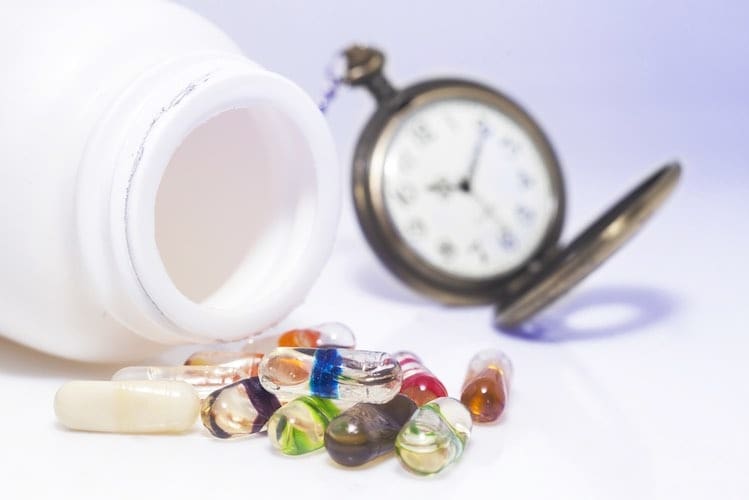
Many people who are taking tablets or other medicines, either on prescription or over-the-counter, are not sure about the best time to take them, especially in relation to meal times and whether to take them in the mornings or at bed time.
The study of when best to take medicines is known as chronotherapy and it is providing useful information to help people manage their conditions optimally.
Should tablets be taken before, during, or after meals?
There is no simple answer to this question. However, as a general rule you should take medicine on an empty stomach (one hour before eating or 2 hours after) unless advised otherwise.
This is because many medicines can be affected by what you eat and when you eat it. For example, taking a pill at the same time you eat may interfere with the way your stomach and intestines absorb the medicine. If you have food in your stomach at the same time as you take a medicine, it may delay or decrease the absorption of the drug.
However, some medicines, such as aspirin and other non-steroidal anti-inflammatory drugs, are easier to tolerate with food. It may be preferable to take them with, or immediately after, a meal to reduce the risk of side effects such as acid reflux and gastric bleeding.
Medicines that cause nausea and vomiting are often best taken after a meal to reduce this effect.
It is sensible to ask your doctor or pharmacist whether it’s okay or preferable to take your medicine with a snack or a meal.
Drug-food interactions
As well as affecting your body’s ability to absorb medicines, some foods can react with the ingredients of a medicine you are taking, stopping the medicine from working the way it should.
Grapefruit and grapefruit juice are good examples of foods that can interfere with how medicines work. They interfere with some of the enzymes responsible for breaking down medicines in the body, leading to increased amounts of the medicine building up in your body. The increased levels of the medicine can lead to more side effects.
Depending on what the medicine is prescribed for, potentially dangerous effects can occur. For example, if an anti-hypertensive medicine builds up, you can have a potentially dangerous lowering of blood pressure.
Such drug-food interactions can happen with both prescription and over-the-counter medicines, including antacids, vitamins and iron pills.
Equally important, and sometimes dangerous, is the chance of a new medicine reacting with one you are already taking, which is why you should always tell your doctor about everything you are taking.
Aside from whether you take medicines before, with, or after food, people commonly ask what time of day is best to take certain medicines. Here are some examples.
When to take your blood pressure medicines
Blood pressure normally decreases overnight, starts to rise before you wake up and then steadily rises during the day.
Diuretics are one type of medicine taken to reduce blood pressure. They increase the need for urination, so they are often taken in the morning to avoid interrupting your sleep. Other anti-hypertensives are also commonly taken in the morning, but a large study in the UK is looking at when is the best time to take blood pressure medicines.
A previous large study (albeit controversial) has shown that taking blood pressure medications in the evenings leads to better controlled blood pressure and a lower risk of death or illness from heart and blood vessel causes.
When to take statins
Statin medicines, which are taken to lower LDL-cholesterol, are generally taken once per day. But when is the best time to take your statin?
Statins work by blocking the enzyme that creates cholesterol and so reduce the amount of cholesterol made by your liver. This enzyme is most active at night – so some manufacturers have suggested it’s best to take statins at bedtime, but it really depends on how long a particular type of statin stays in your system. This is known as the half-life of the particular statin – basically whether it’s a short-acting or long-acting statin. So, always follow your doctor’s instructions or read the consumer medicine information leaflet for when to take your statin. Your doctor will also take into account whether you are taking any other medicines at the same time of day.
When to take osteoarthritis medicines
If you have osteoarthritis, doctors generally advise that you time your dose of pain-killing medicines so that you get the best coverage coinciding with when your pain is worst. Always remember to follow the instructions for the interval between doses. If you take 2 doses too close together you may suffer from toxic effects.
Remember, that non-steroidal anti-inflammatory medicines (NSAIDs) should generally be taken with food to minimise their gastrointestinal effects.
When to take progestogen-only pills (the ‘mini pill’)
It’s very important to take the mini-pill (progestogen-only pill) at the same time each day for it to work effectively. This is more important than for regular birth control pills. The mini pill works differently to regular pills because it works by making cervical mucus thicker and hostile to sperm. It does suppress ovulation, but not consistently.
The mini pill can wear off after around 21 hours in some women, so when choosing what time of day that you are going to take it, take into consideration when you most often have sex. For example, if you most often have sex in the evening, take your mini pill in the morning.
When to take bisphosphonates
Bisphosphonates are medicines for osteoporosis. They are normally taken in the morning because a person has to stay upright for at least 30 minutes after taking them. This is to prevent the medicine coming back into the oesophagus (food pipe) and causing heartburn and irritation.
Drugs with sedative side effects
Drugs that may cause sedation, such as some tricyclic antidepressants, are best taken at night. Other antidepressant drugs, e.g. selective serotonin reuptake inhibitors (SSRIs), can interfere with sleep and are taken in the morning.
Some simple rules
Some simple rules can make the taking of necessary medicines safer.
- Read the label on the container and, if you don’t understand something or need more information, ask the doctor or pharmacist.
- Read the Consumer Medicines Information leaflet for your medicine.
- If a doctor prescribes a medicine for you, make sure the doctor knows all the other medicines you are taking. This includes any prescription, over-the-counter and complementary medicines, as well as any herbal preparations.
- Read directions, warnings and interaction precautions printed on all medicine labels and packages. Even over-the-counter medicines can cause problems.
- Take medicine with a full glass of water (unless advised otherwise).
- Don’t stir medicine into your food, chew or crush tablets, or pull capsules apart (unless your doctor tells you to do so), because this may change the way the drug works.
- Don’t take vitamin pills at the same time you take medicine, because vitamins and minerals can interact with some drugs.
- Don’t mix medicine into hot drinks, because the heat from the drink may destroy the effectiveness of the drug.
- Never take medicine with alcoholic drinks.
- If you are having trouble remembering the timing of your medicines, consider getting a pill dosing dispenser or organiser, or setting a medication reminder.
