
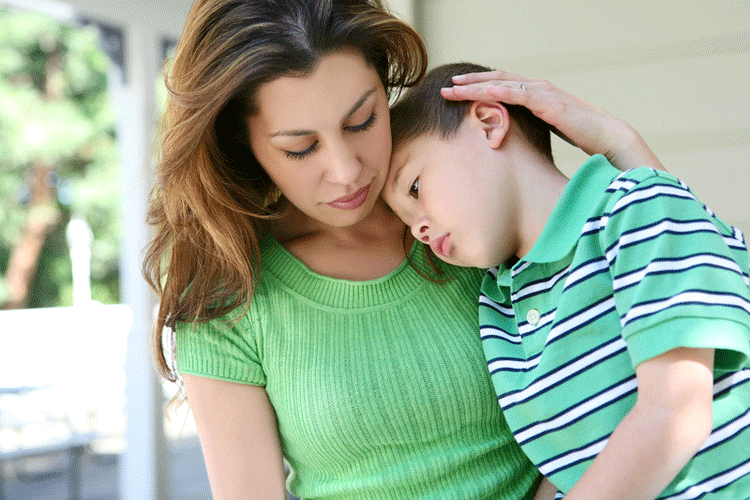
Underwear soiling is a problem that arises in children commonly as a result of chronic (ongoing) constipation. It is known medically as faecal incontinence or encopresis.
Why does faecal incontinence occur?
Nearly all children who soil are constipated. Faecal incontinence due to constipation usually develops because your child continually avoids passing stools, for whatever reason.
It may be because of a painful experience going to the toilet in the past, or because they feel anxious or are too busy playing, or they are not allowed to go to the toilet when the urge arises, or because toilet facilities are unpleasant, or they are teased in the toilets.
Sometimes when a child becomes constipated they end up passing very large movements which cause considerable pain. Sometimes they can even cause small tears around the anus (anal fissures), and this can further frighten your child from wanting to go to the toilet.
Over time, their large intestine fills with faeces and stretches, becoming considerably larger than normal. The formed stool becomes impacted.
The more stretched the large intestine becomes, the less sensitive it is to the nervous stimulation that tells your child that they need to go to the toilet. So the condition becomes self-perpetuating.
As a result, liquid faeces from the small intestine may leak around the harder faeces in the large intestine and onto the underwear. At first it might just seem as if your child is not wiping their bottom properly.
If left untreated, the bowel may expand to the extent that the whole movement just exits into the underwear.
Is faecal incontinence a behavioural problem?
Children with faecal incontinence are not soiling their pants deliberately, and they can’t stop the ‘accidents’ from happening. They are not being lazy or dirty, and must receive medical assistance to help resolve the problem.
If the condition is not managed then it may well lead to the development of behavioural problems associated with shame and embarrassment.
How is faecal incontinence treated?
The treatment for faecal incontinence is similar to that recommended for constipation:
- emptying the large intestine;
- establishing regular bowel movements; and
- keeping regular bowel movements.
To begin with, laxatives are used to empty the intestine. These should be given only under the supervision of your doctor or, for severe cases, in hospital. Laxatives that are taken by mouth are usually recommended – suppositories and enemas are not commonly recommended for children.
All future stools must then be kept soft so that they can be passed regularly. This can take some time and is achieved through a combination of dietary advice and behavioural change (see below) and giving a daily stool softener.
What you can do to help
You should never scold or tell off your child for soiled underwear as a result of leaking stools, because the action is completely involuntary (out of their control). Above all, try to be patient and positive rather than angry, disappointed or exasperated.
Treatment may take many months, and your child will need your encouragement and support during this time. Try to de-mystify the condition by explaining it to them in simple terms.
Toilet times
Regular toilet times are an important part of treating constipation in children. Try to get your child into the habit of going to the toilet after breakfast and dinner, as our bowels tend to contract after we eat. They may have to sit on the toilet for 5-10 minutes. Often children won’t go to the toilet when at school so it is important to make these sessions a habit.
Reward good outcomes
Try to make going to the toilet a positive experience for your child. Reward their successes with hugs and praise. Consider using a star chart, and reward sitting on the toilet, not just producing a stool.
Laxatives
Laxatives may be required for several months, sometimes for up to 6-12 months in younger children, but this should be done under the supervision of your doctor.
In general, stool softeners such as macrogol 3350 or lactulose are the first choice, or lubricant/ stool softeners such as liquid paraffin. Your child’s age will help determine which is the most appropriate choice of laxative.
Stimulant laxatives, such as senna or bisacodyl, and bulking agents, such as psyllium, should be used only if your doctor recommends them. Never give a laxative to a child younger than 3 years old without consulting your doctor.
Diet
Try to ensure that your child’s diet contains adequate fibre and fluid (water and fruit juice).
Good sources of fibre are cereals, brown rice, bran, prunes and high-fibre breads.
Medical help
Consult your doctor for help with underwear soiling in your child. Your doctor is best placed to advise you on a programme to help your child and to take any medical action or to organise counselling for your child.
