
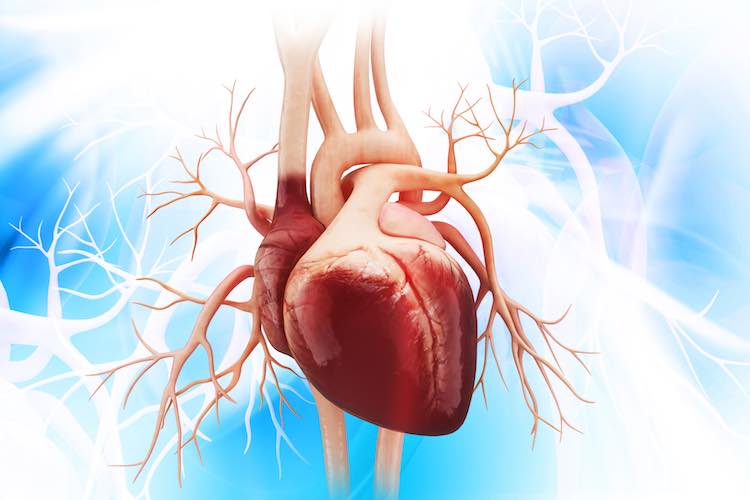

The heart is divided into 4 chambers: 2 on the right hand side and 2 on the left. Each upper chamber is known as an atrium and each lower chamber as a ventricle. The 4 compartments are known as: the right atrium; the right ventricle; the left atrium and the left ventricle. Blood comes into the heart via the atria, which are the smaller chambers, and is pumped out via the larger ones — the ventricles.
Right and left sides of the heart
The right hand side of the heart (shown on the left of pictures and diagrams) pumps blood needing oxygen to the lungs.
This blood goes to the lungs where it is loaded up with oxygen and sent back to the heart. The oxygen-rich blood enters the left side of the heart which then pumps it around the body to where it is needed.
Blood which has delivered its oxygen to the muscles and tissues then returns back to the right-hand side of the heart to start the cycle again.
Superior and inferior vena cavae
These are the 2 large veins which enter the heart on the right hand side and bring blood low in oxygen into the right atrium. The superior (top) vena cava brings in blood from the head and arms and upper body; the inferior (lower) vena cava brings in blood from the trunk and legs — the lower body.
Pulmonary arteries
The right and left pulmonary arteries branch off the main pulmonary trunk. Blood that needs oxygen is pumped into them from the right ventricle and they take it to the lungs where it is loaded up with oxygen.
Pulmonary veins
The right and left pulmonary veins bring the oxygen-rich blood back from the lungs to the heart into the left atrium.
Aorta
The aorta is the largest artery in the body. Blood full of oxygen is pumped by the left ventricle into the aorta, round the aortic arch and out into the upper body via the 3 main arteries branching off the aortic arch and into the thorax, trunk and lower body via the descending aorta.
Valves
Valves are one-way doors. There are valves separating the chambers of the heart. As the heart beats, the valves open and blood is pumped from one chamber to another chamber.
The right atrium and right ventricle are separated by the tricuspid valve. The tricuspid valve lets blood pump from the right atrium into the right ventricle but prevents its flow back again. Similarly, the mitral valve opens from the left atrium into the left ventricle.
The pulmonary valve and aortic valve are at the outlets of the right and left ventricles, respectively.
Heart valve disorders happen when the valves either allow blood to leak backwards, for example, mitral valve regurgitation, or the valves don’t open properly, as in mitral valve stenosis.
Coronary arteries
The heart is just a big muscle which pumps blood around the body. Like all your muscles, the heart needs oxygen to work. This oxygen is brought to the heart by the coronary arteries.
The right and left coronary arteries branch off the aorta — the large main blood vessel which leaves the heart with oxygen-rich blood — so they are ensured of a good blood supply rich in oxygen.
If the coronary arteries become narrowed by fatty deposits in the lining of the arteries (atherosclerosis) then the flow of blood to the heart muscle may be restricted. If the heart muscle doesn’t get enough blood it doesn’t get enough oxygen to work properly — this is called ischaemia.
Ischaemia can cause chest pain or discomfort (angina), often described as a feeling of pressure or tightness in the chest. Angina pain may also be felt in the neck, shoulders or arms. Angina is often brought on by physical activity, and typically improves with rest.
