
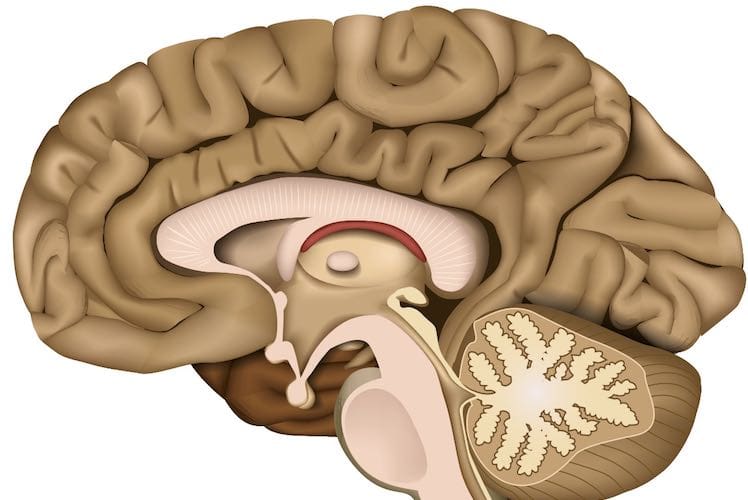
The brain and spinal cord make up your central nervous system — the control centre for the rest of your body. The brain is made up of billions of nerve cells that provide overall control of vital body functions, as well as allow you to think, feel, make decisions, and move. The average weight of the human brain is about 1.4 kilograms.
This side view illustrates some of the many complex structures of the human brain.

Your brain can be divided into 3 main areas:
- the cerebrum;
- the cerebellum; and
- the brain stem.
The cerebrum
The cerebrum is the largest part of the brain, and is responsible for most of our higher thinking processes, including language, memory and cognitive functioning. The cerebrum is composed of an outer layer, known as the cerebral cortex, which is made up of so-called grey matter and contains nerve cells. Underneath the cerebral cortex is the white matter, which consists of nerve fibres that connect the nerve cells to other areas in the nervous system.
The cerebrum is divided into 2 halves, or hemispheres (called the left and right cerebral hemispheres). From the front, these give the brain the look of a walnut with a deep notch running front to back. The 2 hemispheres are connected in the middle by a bundle of nerve fibres known as the corpus callosum. Each hemisphere can be further divided into 4 lobes — the frontal, parietal, temporal and occipital lobes, which each have specific functions.
- The frontal lobes are responsible for a variety of functions, including intellect, speech, and initiating voluntary movements. Your frontal lobes are also the main part of the brain that determines personality and behaviour.
- The parietal lobes are involved with interpreting sensory information from the body (e.g. touch or temperature) and the comprehension of speech. The parietal lobes also help control body movement.
- The temporal lobes are involved with language, memory, emotions, and interpreting sound.
- The occipital lobes are important for vision.
The cerebellum
The cerebellum is the part of the brain that is responsible for co-ordinating voluntary movements and helping you maintain balance. It sits behind and below the rest of the brain, and allows you to make smooth, co-ordinated movements by constantly adjusting muscle tone and posture.
The brain stem
The brain stem includes the midbrain, pons and the medulla oblongata. The brainstem regulates automatic body functions, such as your blood pressure, breathing and heart rate, as well as controlling your level of consciousness.
The meninges and cerebrospinal fluid
The brain is surrounded by several layers of protective tissue known as the meninges, which lie just underneath the skull. The meninges consist of:
- the dura mater (the thick, outer layer);
- the arachnoid (the web-like middle layer); and
- the pia mater (the very thin inner layer that covers the brain and spinal cord).
Clear fluid known as cerebrospinal fluid (CSF) flows around the brain in the space between the pia mater and the arachnoid (called the subarachnoid space), and within the ventricles (4 internal spaces within the brain). The main function of the CSF is to protect the brain by acting as a shock absorber. It may also have a metabolic function.
The substantia nigra
The substantia nigra is an area in the middle part of the brain that is involved in ensuring voluntary movements are smooth and controlled. In people with Parkinson’s disease, the cells in the substantia nigra are damaged, which causes tremors (involuntary trembling or shaking), muscle stiffness and difficulty with movement.
The pituitary gland
The pituitary gland sits at the base of the brain and secretes hormones that control growth, blood pressure and lactation in women. It also regulates the functioning of all the other glands in your body, including your thyroid and adrenal glands, and controls your reproductive organs.
