
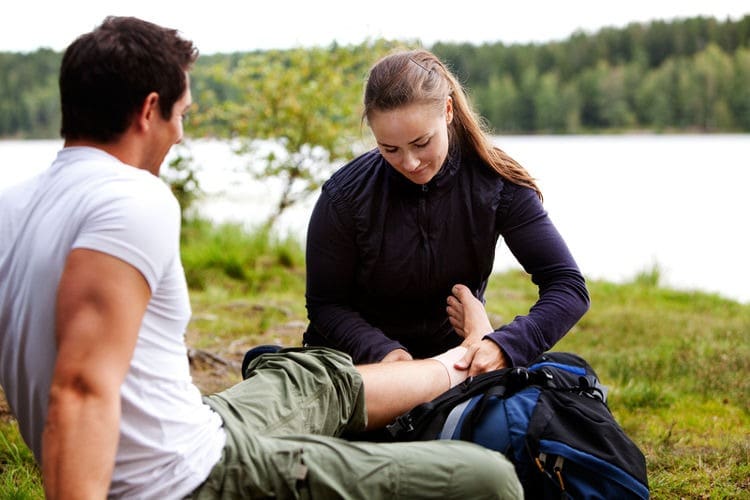
Australia is home to some of the most venomous creatures in the world. Snakes, spiders, jellyfish and molluscs, such as the blue ringed octopus and cone snail, can all inflict a sting or bite that may cause significant illness and occasionally, death.
Snakes

Australian venomous snakes include taipans, death adders, tiger, black, brown, mulga and copperhead snakes as well as many sea snakes. In warmer weather, the land-based snakes are out of hibernation and basking in the sun. Surprisingly, most snake attacks happen near houses, not in the bush.
Most Australian snakes are defensive by nature and will usually sense your approach and move out of the way. Most don’t approach humans unless disturbed, however, some, such as the brown snake, are fast, fierce and easily angered.
Snakebites may be painless, and even though there may only be a light scratch or laceration, it’s important to act as quickly as possible. Blood clotting and life-threatening haemorrhages are a common result of a snakebite.
If someone is bitten by a snake, follow these rules.
DO:
- Apply a bandage over the bite as soon as possible.
- Keep the bitten limb and the patient STILL.
- Place a folded pad over the bite and apply a broad pressure bandage firmly to the limb, including over the pad on the bite site. Apply the pressure immobilisation bandage to the entire limb as far up as possible, starting just above the fingers for an arm or just above the toes for a leg.
- Immobilise the limb with a splint (pressure-immobilisation first aid — see the instructions at the end of this article).
- If the bite is on the trunk or torso, still apply a pressure bandage.
- If the bite is on the head, neck or back, APPLY firm direct pressure on the bite site if possible. Do not restrict breathing, blood flow or chest movement.
- Get the victim to a hospital or medical centre, preferably by an ambulance that has resuscitation facilities and antivenom for snakebites. It is better to keep the bitten person still and bring transport to them, rather than for them to move.
DO NOT:
- DO NOT cut the bitten area.
- DO NOT use a tourniquet.
- DO NOT wash or suck the bite – traces of venom may be needed for use with venom identification kits.
- DO NOT allow the victim to walk or move their limbs about. Carry the person on a stretcher or bring medical help and transportation to the person.
- DO NOT remove the pressure bandage — as venom will quickly enter the bloodstream.
- DO NOT try to catch or kill the snake – the type of snake can be identified from venom on the skin or clothes. In any case, there are new anti-venoms available that act against all types of snakebites, which can be used when the snake is unidentified.
Signs and symptoms of snake bite
Puncture marks may be visible, or a single mark or scratch.
There may also be nausea, vomiting, abdominal pain, diarrhoea, drowsiness, headache, breathing difficulty, trouble speaking or swallowing, blurry vision, fainting, confusion, weakness or difficulty moving limbs.
Spiders
Only 2 Australian spiders, the redback and the funnel-web, pose a threat to human life. Medical treatment is usually not required for white-tailed spider bites, although ice packs may relieve acute pain. Clinical experience appears to be limited with mouse spider bites, but funnel-web spider antivenom could be useful in severe cases.
Some common house and garden spiders deliver bites but usually very little damage occurs. However, medical advice should be sought if there is concern. If it can be done safely, it is reasonable to try to capture and save the spider for identification purposes, even if it has been squashed.
Funnel-web spider

Funnel-web spider bites can be fatal, and life-threatening effects can occur quickly – within 10 minutes. If someone is bitten by a funnel-web spider, follow these rules.
- Check the person’s breathing and circulation. If unconscious follow DRABC plan – Danger, Respond, Airway, Breathing, Circulation.
- Calm the person and keep them STILL.
- Dial 000 for an ambulance. It’s important to get the victim to a hospital, preferably by an ambulance that has resuscitation facilities and antivenom for funnel-web spider bites.
- Apply a broad pressure bandage to the entire limb immediately, especially over the bite site. If bitten on hand, bandage as much of arm as possible, starting just above fingers; if bitten on foot or leg, bandage entire leg from just above toes.
- Apply a splint to the limb, to keep it STILL.
- DO NOT remove the bandage — this will result in spread of the venom into the bloodstream.
- Antivenom is given to people who have symptoms following a funnel-web spider bite.
Signs and symptoms of funnel-web spider bites
Pain at the area of the bite, but little redness or swelling.
Person may be salivating and sweating profusely. They may have numbness or tingling around the mouth. Confusion may develop and there can be difficulty breathing. Muscular spasms can occur.
Redback spider
The bite of a redback spider is immediately painful. Redback spider bites are rarely life-threatening. If someone is bitten by a redback spider, follow these first-aid rules.

- DO apply an ice pack to lessen the pain (the pressure-immobilisation technique is not used in this case as the venom acts slowly and any attempts to stop its movement tends to increase local pain, which may become excruciating).
- DO get the victim to a hospital or medical centre if a child is affected or symptoms are severe.
- Antivenom can be given in hospital to treat pain and other symptoms from redback spider bites, however antivenom is not routinely used for all people following redback spider bites.
Signs and symptoms of redback spider bites
Bites from redback spiders are immediately painful and tend to get worse. The pain may spread. The bite area becomes red, swollen and hot. Small hairs near the bite may stand on end.
There may also be nausea, vomiting and abdominal pain. Also sweating, especially around the bite.
Marine bites and stings
The coastline of Australia, particularly the tropics, holds some perils for the unwary. Box jellyfish or sea wasp (Chironex fleckeri), bluebottles, stonefish, stingrays, blue ringed octopus and cone snails are just some of the ‘nasties’ to watch out for.
Box jellyfish or sea wasp

Box jellyfish are found in tropical Australian waters and stings from box jellyfish can be fatal. First aid for stings includes the following.
- Domestic vinegar should be poured liberally over any adhering tentacles to inactivate the stinging cells (nematocysts) as soon as possible. Flood the area with vinegar for at least 30 seconds.
- If vinegar is not available, wash the area well using sea water (not fresh water) and pick off tentacles (this is not harmful to the rescuer).
- Dial 000 for an ambulance and seek help from a lifeguard.
- Make sure patient does NOT move.
- A cold pack or ice in a sealed, dry plastic bag may help relieve pain. Take care not to get fresh water on the area as it could activate further stinging cells.
- Artificial respiration and cardiac massage (cardiopulmonary resuscitation – CPR) may be required.
- Antivenom is available, and is recommended for all but minor stings.
Note: The use of vinegar for jellyfish stings is to prevent the firing of undischarged stinging cells and the injection of more venom. Vinegar will not decrease pain or lessen the effects of the venom.
Never try to substitute methylated spirits or alcohol, which will cause the nematocysts to discharge and worsen the sting.
Signs and symptoms of box jellyfish or sea wasp sting
Immediate, excruciating pain. Whip-like sting marks on the skin – redness and swelling.
Also nausea, vomiting, sweating, restlessness, headache and collapse. May stop breathing and go into cardiac arrest within a few minutes of being stung.
Bluebottle or Portuguese man o’war

Although painful, bluebottle stings do not usually cause any lasting damage. First aid for bluebottle stings consists of the following.
- Vinegar is NOT recommended.
- Remove any tentacles with tweezers, forceps or fingers (this is not dangerous to the rescuer; you may experience a harmless prickling feeling).
- DO NOT rub the area.
- DO NOT wash off with fresh water — use sea water.
- Immerse the affected area in hot water (no hotter than the rescuer can comfortably tolerate) for 20 minutes to relieve pain.
- If pain is not relieved by heat, or hot water is not available, stings may respond to ice packs or anaesthetic creams or lotions.
- For persistent or generalised pain, or if the sting area is large or involves sensitive areas, call an ambulance and seek assistance from a lifeguard if available.
Irukandji syndrome
Irukandji syndrome can develop about 30 minutes after being stung by some small and medium-sized jellyfish. It can be fatal. First aid for Irukandji syndrome includes the following.
- Call for medical assistance, either via a lifeguard or dial 000 for an ambulance.
- Liberally douse the stung area with vinegar.
- The person must be taken to hospital for pain relief and treatment of symptoms.
Signs and symptoms of Irukandji syndrome
The sting may be mild or not painful, and the jellyfish may be too small to be seen.
Symptoms include severe low back pain, generalised cramping pain, vomiting, sweating, difficulty breathing, restlessness and anxiety. Dangerously high blood pressure may develop.
Stonefish and other stinging fish

There are some fish, such as Stonefish and Bullrout, that can sting when accidentally trodden on, swum over or handled.
First aid consists of the following.
- Call an ambulance.
- Immerse the affected area in hot water to relieve pain. (Try putting an unaffected part of your body in the hot water first to make sure you are not burning yourself.)
- DO NOT apply a pressure immobilisation bandage.
- Leave any barbs or spines in place and place padding around them. They may be plugging a wound and preventing blood loss.
- If the person is unresponsive and not breathing properly, start CPR (cardiopulmonary resuscitation).
You may need hospital treatment for the relief of pain and/or to be given stonefish antivenom.
Signs and symptoms of fish stings
Fish stings are usually extremely painful, which can lead to irrational behaviour. The sting wound may be bleeding, bruised or swollen.
Blue-ringed octopus
Blue-ringed octopuses, often found in rockpools, inhabit all Australian coastal waters.

Can be fatal. First aid for blue-ringed octopus bites includes the following.
- Dial 000 for an ambulance – medical help is needed as fast as possible.
- Pressure immobilisation bandages should be applied, using a broad pressure bandage and splint on the affected limb.
- Stay with the person, reassure them and keep them still.
- Assisted or artificial respiration may be needed.
- Person will need transfer to hospital – prolonged artificial respiration is often required until the effects of the venom wear off.
- There is no antivenom available.
Signs and symptoms of blue-ringed octopus bite
Blue ringed octopuses secrete a nerve toxin in their saliva. Their bite is usually painless, but the person bitten will feel numb around the mouth, tongue, face and neck and will feel tight in the chest and may have difficulty breathing.
Respiratory failure occurs eventually which leads to death if the person is not resuscitated. Most of the time, the victim is aware, but unable to move or respond.
Cone shell/snail

Living in shallow reef waters, these conical shells contain a snail which kills its prey with venom. The venom of the cone snail is injected by small teeth which look like harpoons. Cone shell stings can be quickly fatal if large amounts of venom are injected.
- Call 000 for an ambulance.
- Pressure immobilisation, using a broad pressure bandage and splint, is recommended.
- Stay with the person, reassure them and keep them still.
- Prolonged artificial respiration, even mechanical ventilation, may be required.
- At this stage, there is no antivenom available for cone shell stings.
- A tetanus injection may also be needed in case the wound is contaminated.
Signs and symptoms of cone shell sting
Pain, swelling and numbness at sting site. The venom causes prolonged weakness of muscles, including the muscles of respiration (breathing), and disturbance of vision, speech and hearing.
Difficulty breathing can lead to respiratory failure and ultimately death if person is not resuscitated. If untreated, high levels of venom could cause death in a short time.
Paralysis tick

The Australian paralysis tick secretes a nerve toxin in its saliva. The tick may not be noticed until a search is instigated for it.
Australian experts recommend the following first aid measures for attached adult ticks.
- Kill adult ticks where they are on your skin using a spray that contains ether (available from pharmacies in Australia). These sprays freeze the tick, killing it and preventing it from injecting its saliva or regurgitating its contents into you.
- You should then leave the tick in place until it drops off, which should happen in the next 24 hours. Don’t compress it or squeeze the tick during this time.
- Once the tick has dropped off, clean the area with an antiseptic or soap and water.
- Don’t remove ticks with household tweezers. If you have trouble killing the tick or it doesn’t drop off, visit your doctor for tick removal.
- Seek medical attention if you develop symptoms such as rash, swelling or fever.
In short: Freeze it; Don’t squeeze it!
To kill small tick larvae or nymphs, apply insecticide cream containing permethrin, which is available from chemists.
Note: Avoid using methylated spirits, kerosene or other chemicals — this may cause the tick to inject more toxins.
Signs and symptoms associated with Australian paralysis tick
There may be local irritation at the site of the tick.
The symptoms of tick paralysis (which is rare) progress from local irritation at the site of the tick and tiredness to muscle weakness, unsteadiness on the feet, double vision and difficulty in swallowing or breathing to (rarely) paralysis. Most human cases of tick paralysis are seen in children.
Sometimes infections can be transmitted via tick bites. Squeezing or disturbing a tick can result in it injecting its saliva into you, and expose you to transmissible diseases from the tick, sensitise you to ticks or meat in the future (mammalian meat allergy), or if you suffer from tick allergy, risk you having a severe allergic reaction.
Information on pressure immobilisation first aid
Pressure immobilisation first aid for venomous bites and stings was developed in Australia in the 1970s by Professor Struan Sutherland, who was head of immunology research at the Commonwealth Serum Laboratories (CSL).
Venom is spread via the lymph system, so applying a bandage (as tightly as you would strap a sprained ankle) slows the movement of venom from the bite site through the lymphatic system and into the blood circulation. Immobilisation of the limb — with a splint, e.g. a piece of wood/timber — also slows lymphatic drainage. Pressure immobilisation bandaging may also inactivate some types of venom by trapping the venom in the tissues.
This gives the bitten person more time to reach hospital and medical care, although obviously the situation is still a grave emergency.
Research with snake venom has shown that very little venom reaches the bloodstream if firm pressure is applied over the bitten area and the limb is immobilised. Pressure immobilisation first aid is currently recommended for most life-threatening venomous bites and stings in which the venom travels by the lymph system, for example, funnel-web spider bites, snake bites and blue ringed octopus and cone snail envenomations.
Applying the pressure immobilisation technique (PIT)
The pressure immobilisation technique (PIT) involves bandaging the limb that has been bitten and keeping it still using a splint or sling. To apply the pressure immobilisation technique:
- Apply a broad pressure bandage (preferably an elasticised bandage, 10-15 cm wide) to the bite area.
- If you don’t have any elasticised bandages, use crepe bandages. Other material (such as clothing) can be used if there are no bandages available.
- The bandage should be tight enough that you can’t comfortably get a finger underneath the bandage.
- Apply a second pressure bandage to the entire affected limb, starting at the fingers or toes and moving upwards. The bandage should be applied over the person’s clothes.
- If you have only one bandage, simply apply that bandage starting at the fingers or toes and bandage up the limb, including the bite site.
- A splint should also be applied – incorporate the splint under the bandage layers to keep the limb still. The joints on either side of the bite should be immobilised by the splint. For bites on the legs, one leg can be splinted to the other by strapping them together. Arms should be placed in a sling.
- If you are by yourself, use the PIT if possible. If you need to move to call for help, apply local pressure.
