
What is sudden infant death syndrome (SIDS)?
SIDS is ‘the sudden and unexpected death of an infant under one year of age with an onset of a fatal episode occurring during sleep, that remains unexplained after a thorough investigation, including performance of a complete autopsy and review of the circumstances of death and the clinical history’.
What is sudden unexpected death in infancy (SUDI)?
The term Sudden Unexpected Death in Infancy (SUDI) is now used as this term refers to all cases of sudden and unexpected death in infancy and includes deaths from the Sudden Infant Death Syndrome (SIDS) and fatal sleeping accidents. Safe sleeping recommendations target known risk factors associated with SUDI.
Is it safe to sleep with my baby?
Babies should be slept in their own sleep space, which is safest in a cot or bassinette. Some families choose to bring baby to bed with them, but this isn’t always safe.
Read the advice below on how to do it more safely, to reduce your risk.
Tips for safer co-sleeping
Follow these tips for safer co-sleeping:
- Place baby on their back to sleep – never on their tummy or side
- Make sure the mattress is clean and firm
- Keep pillows and adult bedding away from baby
- Make sure baby can’t fall off the bed– you can also put the adult mattress on the floor to help reduce the risk of baby being injured from falling off the bed.
- Make sure your bedding and sheets can’t cover baby’s face
- Place baby to the side of one parent – never in the middle of two adults, or next to other children or pets
- Move the bed away from the wall – so baby can’t get trapped between the bed and the wall
- Dress baby in a safe sleep bag with no hood but with a fitted neck and armholes – don’t wrap or swaddle baby
- Tie up long hair, remove all jewellery and remove teething necklaces – so they can’t strangle baby.
When not to co-sleep:
You should never co-sleep or lie down holding baby if:
- You are overly tired or feel unwell
- You or your partner have recently drunk alcohol
- You or your partner smoke, even if you don’t smoke in the bedroom
- You or your partner have taken any drugs that make you feel sleepy or less aware
- Baby is unwell, was premature or is small for their gestational age.
Room sharing
Room sharing reduces the risk of SIDS, SUDI and fatal sleep accidents during day-time and night-time sleeps.
Room sharing with a baby has been shown to reduce the risk of sudden unexpected infant death. Red Nose therefore recommends sleeping with a baby in a cot next to the parents’ bed for the first six to twelve months of life.
- Parents are advised to share the same room as their baby during the first 6-12 months of life as this practice reduces risk of sudden infant death.
- Placing a baby in the supine position and keeping them under supervision is equally important for night-time and day-time sleeps.
- Room sharing is recommended for all babies, although the room where baby sleeps should be kept smoke free.
- Parents who are smokers are encouraged to room share (but not share the same sleep surface), as long as the room that baby sleeps in is kept smoke-free.
- Safety of the baby’s sleep environment is a priority over sharing the same room as the baby for daytime sleeps
- Parents are not expected to observe baby constantly. If baby is sleeping in a separate room check baby regularly to ensure that the baby remains on the back and the head and face remain uncovered (as baby grows beyond 5-6 months they will move around the cot and roll over; settle baby to sleep on their back but let them find the sleep position they feel most comfortable in. A safe cot and safe sleep environment is still necessary for older babies).
Can baby be slept on the side?
Placing babies to sleep on the side doubles the risk of SUDI (SIDS and fatal sleeping accidents) and is not recommended as a safe alternative to sleeping a baby on the back. The side position is unstable: a baby is likely to roll into the high risk tummy position, placing the baby at nine times the risk of SUDI.
Can babies be put on their tummy to play?
Yes. Tummy play is safe and very important for babies from birth, but only when they are awake, not too tired and supervised by an adult. Tummy play helps muscle development in the arms, neck and back and prepares babies for crawling. Tummy play is also very good to help prevent a misshapen (flat) head but remember not to put baby on the tummy to sleep.
Will baby choke if he/she vomits while sleeping on the back?
Healthy babies placed to sleep on the back are less likely to choke on vomit than tummy or side sleeping infants. In fact, sleeping baby on the back actually provides airway protection.
- When a baby is sleeping on the back, the upper respiratory airways are positioned above the oesophagus (food pipe:the tube that carries food from the mouth to the stomach). Babies protect their airways by swallowing. Regurgitated milk from the oesophagus lies at the lowest level and can be easily swallowed. It is difficult for the fluid to work against gravity and be pushed up and into the respiratory tract. Hence, the risk of choking is reduced when baby is sleeping on the back.
- When a baby sleeps on the tummy, the oesophagus sits above the baby’s upper airways. Babies sleep more deeply on their tummy and swallow less frequently. If a baby regurgitates or vomits milk or fluid, these substances will pool at the opening of the airways and are more likely to be inhaled into the baby’s airway and lungs.
- When a baby sleeps on the side, there is still an increased risk of him or her breathing in fluid into his or her airway and lungs. Hence choking is less likely when a baby sleeps on the back. In fact, babies swallow and clear fluids better when lying on their back.
Is the bedding safe?
Red Nose recommends baby sleeps on the back, ensuring that his/her face and head remains uncovered during sleep.
A good way to achieve this is to place baby in a safe infant sleeping bag (a safe infant sleeping bag is designed especially for baby, with fitted neck and armholes and no hood).
If a blanket is being used instead of a sleeping bag, ensure baby is placed with his/her feet at the end of the cot, tucking the blanket in securely underneath the mattress, so it can only ride up as far as baby’s chest and cannot cover his/her head.
Ensure there is no soft bedding in baby’s sleep environment. Soft bedding (pillows, doonas, loose bedding or fabric, lambswool, bumpers or soft toys) in the cot is unnecessary and may cover baby’s face and obstruct baby’s breathing.
How to make up baby’s cot
The safest place for a baby to sleep is in a safe cot in the parents’ room for the first 6-12 months of life. When you are making up baby’s cot, keep in mind the following advice:
- Use a safe cot that meets the current Australian Standard AS2172
- Use a safe mattress: firm, clean, flat (not tilted or elevated) and that is the right size for the cot.
- Sleep baby on back
- Keep head and face uncovered
- Position baby’s feet at the bottom of the cot
- Tuck blankets in firmly or use a safe baby sleeping bag
Do not use pillows, doonas, soft toys, cot bumpers or lambswools anywhere in the cot.
Do not put your baby to sleep on a water bed or bean bag.
Ensure your cot complies with Australian Standard 2172:2003 and if using a portable cot ensure it complies Australian Standard 2195:2009. When purchasing these products remember to look for the Australian Standard labelling.
How much bedding does baby need?
Thermal stress (overheating) has been implicated in SIDS and SUDI for many years and avoiding overheating has been one of the strategies to reduce risk of SUDI.
Key points on how much bedding should be placed on baby in a sleeping environment
- Dress baby and use layers as you would dress or use layers yourself: to be comfortable, neither too hot nor too cold.
- Research has shown that baby’s risk of dying suddenly and unexpectedly is increased if baby is sleeping on the tummy and that risk is even further increased if baby is sleeping on the tummy under heavy bedding or if baby’s head becomes covered by bedding in any position. Babies manage heat loss very efficiently when placed on the back to sleep with the head uncovered. Sleep baby on the back and keep baby’s head uncovered during sleep to reduce baby’s risk of sudden unexpected death.
- Make up baby’s bed so baby sleeps at the bottom of the cot and the blankets can only reach as far as baby’s chest, ensuring baby cannot move down during sleep and get his/her head covered by bedding.
- Consider using a safe baby sleeping bag (one with fitted neck, armholes or sleeves and no hood).
- Dress baby for sleep and add/remove lightweight blankets to ensure baby’s back or tummy feels comfortably warm to the touch.
- Remove hats, bonnets, beanies and hooded clothing from baby’s head as soon as baby is indoors.
More details
Since the introduction of public health programs promoting ‘back-to-sleep’ to reduce the risk of SUDI, there has been a significant reduction in the number of babies dying suddenly and unexpectedly. However, tragically, around 113 babies die suddenly and unexpectedly every year in Australia and it is important to keep following evidence-based recommendations on ways to avoid risk factors related to baby’s sleep environment.
The association between overheating and SUDI has been known for several years particularly if baby’s head is covered. Current research confirms that if your baby becomes too hot, the risk of SUDI is increased. Overheating can be caused by room heating, high body temperature, excessive clothing or bedding and head covering. To reduce the risk of this, Red Nose recommends that you, as baby’s parent or carer, use your own judgement, taking into account factors such as where you live (climate, whether it is summer or winter), whether you have heating in the house, and whether baby has a cold or minor illness (which may cause their temperature to rise).
A useful guide is to dress baby as you would dress yourself: to be comfortable, neither too hot nor too cold. If baby has a minor illness and has a temperature it is common for parents or carers to overdress baby for sleep but in fact, fewer bedclothes should be used or, at times, none at all. If parents or carers are worried that baby is ill they should talk to their baby’s doctor and have the baby assessed.
Both hyperthermia (unusually high body temperature) and hypothermia (unusually low body temperature) are important to avoid during infancy.
Baby’s face and head should always remain uncovered. Baby’s head (particularly the face) is the main route for heat loss. Overheating has been found to be related to SUDI and the risk of overheating is increased if baby is sleeping on the tummy. This is especially dangerous if baby is under heavy bedding as, if baby should roll over onto the tummy, then the risk of overheating is even further increased. In fact, research has shown that babies sleeping on the tummy are at ten-fold the risk of SUDI while sleeping in a heated room.
Increased temperature has been shown to alter infant physiology by increasing respiratory and heart rate and in some studies the frequency of central apnoeas. Increased temperature, whether due to head covering or by increasing room temperature depresses arousal responses and reduces autonomic control of heart rate. Both impaired respiratory control, arousal from sleep and autonomic cardiovascular control have been implicated in the final mechanism of SIDS.
Bedding for babies who have a cold
Research has shown that babies with symptoms of a common cold are often given more bedding than they need due to care giver concerns that babies showing signs of a cold need to be kept very warm. In fact, providing assistance to babies with a common cold to effectively regulate their temperature is very important. This can be best achieved by placing them on the back to sleep with the head uncovered and removing some bedding or clothing.
If baby is overly warm to touch, or showing signs of heat stress (irritability, looking unwell, floppy, drier skin, refusing to drink or having fewer wet nappies than usual) then see your doctor or health professional immediately.
Can we say exactly how many blankets to use when baby is placed to bed?
The simple answer is – no. Red Nose recommend that rather than state how many bedclothes can be safely placed on a baby, parents can work out the amount of bedding to be used after considering these factors:
- The room temperature where baby is sleeping.
- How hot does the baby feel? A good way to check baby’s temperature is to feel baby’s back or tummy (don’t worry if baby’s hands and feet feel cool – this is normal).
- Whether the baby has a cold or infection or another special need.
- Consider how many layers that you as the baby’s carer are wearing comfortably.
Sleeping baby in a safe baby sleeping bag: one designed especially for baby with fitted neck and armholes and no hood, has a number of features that help baby sleep safely. Research has shown that sleeping bag use will reduce the risk of bedclothes covering the baby’s face, will delay baby rolling onto the tummy during sleep until baby is past the age of peak risk of SUDI, promotes supine sleep as the zipper opens to the front and will keep baby’s temperature at a more constant level while sleeping at home.
If blankets are being used instead of a sleeping bag, it is best to use light weight blankets in layers that can be added or removed easily according to the room temperature and which can be tucked underneath the mattress.
Always remove hats or bonnets or beanies from baby as soon as you come indoors or enter a warm car, bus or train, even if it means waking the baby. Never use electric blankets, wheat bags or hot water bottles for babies.
Is it safe to wrap/swaddle my baby?
Wrapping can be a useful method to assist baby to settle and stay asleep as it reduces crying time and episodes of waking. Wrapping has also been shown to provide stability, which may help to keep babies in the recommended back position.
Tummy sleeping increases the risk of SIDS and must be avoided. Wrapping a baby in the tummy position is even more dangerous as it prevents baby moving to a position of safety.
When wrapping baby:
Ensure that baby is positioned on the back with the feet at the bottom of the cot, that he/she is wrapped from below the neck to avoid covering his/her face and always sleep baby with face uncovered (no doonas, pillows, cot bumpers, lambswool or soft toys in the sleeping environment).
Use only lightweight wraps such as cotton or muslin (bunny rugs and blankets are not safe alternatives as they may cause overheating).
For wrapping to be effective, the wrap needs to be firm but not too tight. Techniques that use tight wrapping with legs straight and together increase the risk of abnormal hip development, while loose wraps are also hazardous as they can cover baby’s head and face.
Ensure that baby is not over dressed under the wrap. Use only nappy and singlet in warmer weather and dress baby in a lightweight grow suit in cooler weather.
When not to wrap baby
If you wrap your baby, consider baby’s stage of development. Leave arms free once the startle reflex disappears around 3 months. Most babies eventually resist being wrapped. Wrapping style should be appropriate for the baby’s developmental stage.
It is essential to discontinue wrapping as soon as baby starts showing signs that they can begin to roll, usually between 4-6 months of age but sometimes younger. Babies must not be wrapped if sharing a sleep surface with another person. Baby should not be wrapped while sleeping in a baby sleeping bag.
Does Red Nose recommend mattress wrapping?
No. Wrapping a baby’s mattress with polythene has been suggested as means of preventing SIDS. The theory proposes that cot mattresses emit toxic gases and that wrapping the mattress will prevent SIDS.
This theory has been thoroughly investigated through rigorously conducted, scientifically based research and there is no evidence to support the link between wrapping mattresses and the prevention of SIDS.
The safest place to sleep baby from birth is in a safe cot, which complies with the AS/NZS mandatory standards for either household or folding (portable) cots, in the same room as an adult caregiver for the first six to 12 months of life.
Do baby monitors reduce the risk of sudden unexpected death in infancy?
There is no scientific evidence that electronic baby monitors are of any assistance in preventing SIDS and have played no part in the dramatic reduction in SIDS deaths in Australia.
Monitors are not indicated for normal healthy babies and toddlers:
- There is no scientific evidence that using any type of monitor will prevent a sudden unexpected infant death.
- Some manufacturers of home monitors make false claims that they prevent sudden death
- Monitor use is disruptive for most families and unnecessary for most babies
- Monitor use is helpful for some babies and some families.
- Monitors should only be used under the supervision of a doctor or nurse
The reduction in the number of babies dying of SIDS has come about because parents have been made aware of ways to sleep baby safely such as placing baby on the back to sleep from birth, sleeping baby with face uncovered, not smoking during pregnancy or after the birth, and by providing a safe sleeping environment.
Does dummy use reduce the risk of sudden unexpected death in infancy?
- There is strong evidence that dummies are associated with a reduced risk of sudden infant death when used consistently.
- Mechanisms that provide this protection are not understood and pacifier use may possibly be a marker from something else, as yet not identified.
- Dummy use is associated with advantages including a reduced risk of sudden infant death, and effective infant settling.
- Dummy use is associated with disadvantages including a potential negative impact on breastfeeding, and a higher incidence of respiratory, ear and gastrointestinal infections, accidents and dental malocclusion.
- In some countries, dummy use is promoted as a SIDS risk reduction strategy.
- In other countries dummy use is not actively discouraged, but is not advocated as a risk reduction strategy.
- Sleeping a baby on the back, with face uncovered, and in a smoke free environment is the best way to protect a baby from sudden and unexpected infant death.
Are there specific baby care products that reduce the risk of sudden unexpected death in infancy?
There is no scientific research evidence that has convinced Red Nose that any specific baby care product reduces the risk of SIDS or sleeping accidents.
Is it safe to use products designed to keep baby in a particular position during sleep?
No. Red Nose does not recommend positional products such as anti-roll devices and items that fasten a baby into a sleeping position. Products that restrict the movement of a baby or a baby’s head should not be used. This is because there are no Australian Standards for these products and case studies have shown that these products can be unsafe.
There is strong scientific evidence to show that the best way to reduce the risk of SIDS and sleep accidents is to sleep babies on their back with face and head uncovered, to avoid exposing babies to tobacco smoke and to provide a safe sleeping environment.
Can baby use a pillow to prevent flat head?
No, pillows are not recommended to prevent a flat head, in fact, pillows are not necessary for baby for any reason as they increase baby’s risk of sudden unexpected death in infancy, including SIDS and fatal sleep accidents. Red Nose does not recommend placing a pillow in baby’s sleep environment.
A pillow may cover the baby’s face and obstruct breathing or cause overheating. Furthermore, when a baby falls asleep propped up on a pillow, his/her head can fall forwards, pushing his/her chin down towards his/her chest. This can lead to his/her airway becoming blocked and reducing airflow.
Older babies in a cot can be at an increased risk of a sleeping accident by using pillows as a step to climb up and fall out of the cot.
Red Nose recommends delaying offering a pillow until baby is over two years of age and is no longer sleeping in a cot or portable cot
Can my baby have a soft toy?
Soft toys should never be placed in the sleeping environment. Soft objects in the cot can be a suffocation risk.
Keep soft toys out of the sleeping environment for babies under seven months of age because they may cover the nose and mouth and interfere with breathing.
The risk posed by suffocation by the presence of soft objects in the baby’s sleeping environment outweighs any benefit to the baby from a soft toy. It is therefore advised not place soft toys and other soft objects in the cot for babies under seven months of age.
Seven month old babies are more likely to explore objects in their sleeping environments than younger babies. Some babies over seven months of age may appreciate a small object such as a soft toy to provide comfort and connection (transitional object1) during times of separation from their parent.
Keep the cot free of large soft toys, pillows, bumpers, activity centres and anything else that could be ‘stacked’ to assist a young child/toddler to climb out of the cot.
What is a safe sleeping bag for a baby?
A safe baby sleeping bag is constructed in such a way that the baby cannot slip inside the bag and become completely covered. The sleeping bag should be the correct size for the baby with a fitted neck, armholes (or sleeves) and no hood.
When using a sleeping bag, ensure that baby is dressed according to the room temperature. In cool climates, dress baby in layers of clothing within the sleeping bag. If additional warmth is needed, use a single, lightweight blanket over the sleeping bag, ensuring baby’s feet are at the end of the mattress and the blanket can only reach as far as baby’s chest and is tucked in firmly so it cannot ride up and cover baby’s head during sleep.
Benefits of using a safe baby sleeping bag
Research has shown that among the benefits of using a safe baby sleeping bag (a safe baby sleeping bag has fitted neck and armholes and no hood and is the correct size for baby) are:
- they reduce the risk of bedclothes covering baby’s face
- they delay baby rolling onto the tummy during sleep until baby’s past the age of peak risk of SUDI
- they promote back sleeping as the zipper opens to the front
- they will keep baby’s temperature at a more constant level while sleeping
Does sleeping with a baby on a sofa or couch increase the risk of sudden unexpected death in infancy?
Yes. There is a very high risk of a sleeping accident if an adult falls asleep with an infant on a sofa. This is because baby may become wedged into cushions or the back of the sofa and the sleeping person would not notice. Put baby back into his or her own sleeping place before you doze off on a sofa.
Never fall asleep with baby on your chest whilst lying down as this is the same as sleeping the baby in the tummy position.
Is it safe to sleep baby on a baby bean bag?
No.
The safest place to sleep baby from birth is in a safe cot, which complies with the AS/NZS mandatory standards for either household or folding (portable) cots, in the same room as an adult caregiver for the first six to 12 months of life.
It may have been suggested by family and friends that you sleep baby on a beanbag. However, it is not safe to do so.
A bean bag, defined as a material sack encasing a large quantity of polystyrene foam beads that is usually a pyramid-shaped sack used for seating, poses a suffocation risk to babies and small children and a choking hazard if they inhale the beads.
Is it safe to use a second hand mattress?
Red Nose recommends babies sleep on the back and on a firm, clean, well-fitting mattress that is in good condition and placed flat (not tilted or elevated).
Over the years there has been attention in relation to a theory that there may be a link between SIDS and a certain bacteria found in second hand mattresses.
However, the bacteria in question are normally found on the skin and in the nose and throats of healthy adults and infants. There is no evidence to show that there is an increased risk of SIDS for babies who sleep on a second hand mattress providing that baby:
- Sleeps on the back
- Sleeps on a flat, firm, clean, well-fitting mattress that is in good condition
- Sleeps with no bedding covering the face or head
- Is not exposed to tobacco toxins before birth or after
At what age can i introduce cot bumpers and pillows?
Soft bedding is dangerous in a cot and should not be used. Soft bedding includes pillows, quilts, doonas, soft toys and bumpers. Soft bedding may cover the baby’s face and obstruct breathing and/or cause overheating.
Older babies in a cot can be at an increased risk of a sleeping accident by using pillows and bumpers as a step to climb up and fall out of the cot. It is safer to wait until the child starts to sleep in a bed before introducing a pillow or other soft bedding.
Is it ok for babies to wear a necklace or beads?
Red Nose does not recommend placing anything around the neck of a sleeping baby as this could tighten during sleep and make breathing difficult and may even strangle baby. Furthermore, strings of beads could break and individual beads could end up in a baby’s mouth, presenting a choking hazard.
The Australian Government has issued a warning notice about the use of amber teething necklaces (bracelets and necklaces of amber beads). Testing of several of these products indicated that they could break into small parts and present a choking hazard to children under three years of age.
In 2011, Parliamentary Secretary to the Treasurer, David Bradbury issued a warning notice to the public in relation to amber teething necklaces.
Amber teething necklaces and bracelets consist of amber beads which are a fossilised tree resin and range in colour from yellow to white and beige to brown.
The warning notice was issued after ACCC testing of several of these products indicated that they could break into small parts and present a choking hazard to children under three years of age.
Suppliers claim that when worn close to the skin, succinic acid will be released by the amber beads to relieve the symptoms of teething. Some suppliers also make claims for other conditions including eczema and asthma.
Consumers using this product are advised to:
- always supervise the infant when wearing the necklace or bracelet
- remove the necklace or bracelet when the infant is unattended, even if it is only for a short period of time
- remove the necklace or bracelet while the infant sleeps at day or night not allow the infant to mouth or chew the necklace or bracelet
- consider using alternate forms of pain relief
- seek medical advice if you have concerns about your child’s health and wellbeing.
Is immunisation linked with sudden unexpected death in infancy?
No. The peak age of SIDS is the same age that babies are most often immunised (two to four months of age), so by chance they can occur at the same time.
However, there is strong evidence to show that immunisation is not associated with SIDS and that immunised babies are actually at a lower risk, so immunise your baby on time.
Red Nose recommends immunisation for babies for many health benefits including a lower risk of SIDS. Immunisation is a simple, safe and effective way of protecting people against some diseases. The risks of these diseases are far greater than the risks of immunisation.
Sleeping position for babies with gastro-oesophageal reflux (gor)
Gastro-Oesphageal Reflux (GOR) is the effortless regurgitation or spitting up of gastric (stomach) contents into the oesophagus (food pipe) with or without effortless regurgitation and vomiting.
Gastro-Oesphageal Reflux Disease (GORD) occurs when the reflux of gastric (stomach) contents causes troublesome signs and/or complications, that is, when GOR has an adverse effect on the well-being of the baby. For example, when the GOR causes poor weight gain or complications such as oesophagitis or respiratory signs. This requires medical assessment before a diagnosis of GORD is made.
Regurgitation in children is defined as the passage of refluxed contents into the throat, mouth or from the mouth. Other terms include “spitting up”, “positing” or “spilling’. It is a characteristic sign of reflux in infants but is not diagnostic of GORD 1. Regurgitation in infants is normal. It is normal for up to 50% of babies less than three months of age and 70% of completely healthy infants under twelve months of age to have regurgitation that is physiologic. Most of this regurgitation resolves spontaneously after 6 months, and completely by twelve months in 95% of babies.
Babies with GOR should be placed to sleep on their back from birth on a firm, flat mattress that is not elevated.
- In babies with GOR, the risk of sudden death when baby is in the tummy or side sleeping positions outweighs any benefits of tummy or left side positioning of babies.
- Elevating the sleeping surface for back sleeping babies does not reduce GOR and is not recommended.
- If a baby is in an elevated cot, further hazards may be introduced into the sleeping environment. When elevated, babies are more likely to slip down the cot and become completely covered by bedding, or if a pillow is used to elevate the baby pillows become a suffocation hazard.
- If for a rare medical reason a baby must be slept in a position other than the back position, medical staff should advise the parents in writing and provide information about the other ways parents can reduce the risk of SUDI.
- Medical assessment is required for a diagnosis of GORD.
- Non-nutritive sucking using a pacifier or dummy has no effect on acid or non-acid GOR and thus can be used in preterm infants with GOR symptoms.
Positioning for sleep
Sleeping baby on the back provides airway protection. The back sleeping position is safer for babies with GOR as babies can protect their airways when placed on the back compared with babies placed to sleep on the tummy or side.
The tummy or side positions should not be used for babies including those with GOR or GORD unless parents are advised in writing by the child’s medical practitioner. The American Academy of Pediatrics advises that the back sleeping position be recommended in the treatment of gastro-oesophageal reflux for mild to moderate cases. The tummy and side sleeping positions significantly increase the risk of sudden infant death for babies under six months of age.
Elevating the cot during sleep is not recommended
In a critical review of the literature elevating the head of the cot in the supine position does not reduce GOR 7. It may cause the baby to slide down to the foot of the cot into a position that might compromise breathing. Placing a pillow or wedge under the mattress or in the cot with the aim of elevating the baby’s head is also not recommended as it increases the likelihood of baby slipping down under the bedding and the baby’s head becoming covered 5.
Elevating a baby during feeding and tummy time
While props in the shape of a wedge may provide an aid during feeding, and tummy time while the baby is under supervision, they should never be used during sleep or when baby is awake and not being watched by an adult.
Sleep positioners are not recommended
Aids and devices intended to keep babies in certain sleeping positions are NOT recommended; they do not prevent babies from rolling on to the tummy (prone) position, and they limit the baby’s movements as they get older. These products have not been researched and, like other soft products in the cot, may create a suffocation risk 5.
Rare situations where the tummy sleeping position is recommended for medical reasons
If the child’s medical practitioner determines that the stomach sleeping position is necessary because of a rare medical condition or other concern, the medical practitioner should advise the parents in writing. The medical practitioner should also provide information about the child care practices that reduce the risk of sudden infant death.
GOR Medications in preterm and term infants should be carefully evaluated especially in the high risk preterm population as there is uncertain evidence of efficacy and potential harms.
Sleeping twins safely at home
Although surveys demonstrate that co-bedding twins at home is common (> 50%) current evidence shows that the safest way to sleep twins at home is to place them in their own cot and follow the Red Nose safe sleeping guidelines. These guidelines aim to reduce the risk of SUDI, including SIDS and fatal sleep accidents. The American Academy of Pediatrics also advises separate sleep surfaces and to avoid co-bedding for twins (and higher order multiples) in both hospital and at home.
Co-bedding twins would be dangerous if one part of the body of one twin were able to accidentally cover the face of the other causing an interference with breathing. A small observational study of 10 twin pairs sleeping in various side by side and head to head configurations showed that twins sleeping side by side occasionally impinged on, although did not obstruct, the airway of the other twin.
Sleeping twins safely when separate cots are not available
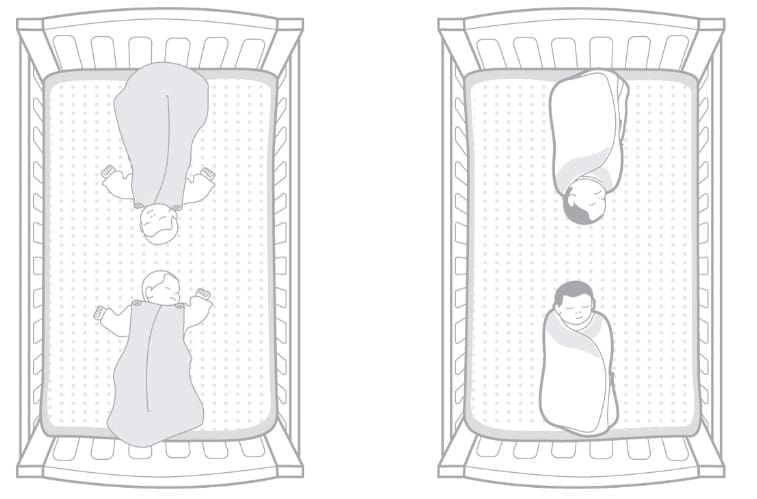
Sometimes parents and carers of twins may need to sleep twins in the same cot temporarily, for example when travelling or visiting, if there is insufficient space for two cots in the room. In these circumstances, ways to minimise the risks for twin babies sharing the same cot include:
- Place the babies head to head, at opposite ends of the cot (see diagrams below)
- Never place the baby in the cot with any other children
- Do not use bedding. Safe alternatives to bedding include:
- Wrap the babies separately according to Red Nose guidelines (from birth until showing signs of being able to roll over)
- Sleep the babies in separate safe infant sleeping bags (for babies weighing 3.2kg and over)
When the babies are able to move freely around the cot, place them to sleep in separate cots.
In Australia, between 1990 and 2015 approximately 5,000 babies died suddenly and unexpectedly. Baby deaths attributed to SUDI have fallen by 85% and it is estimated that 9,967 infant lives have been saved as a result of the infant safe sleeping campaigns.
The Safe Sleeping program is based on strong scientific evidence, has been developed in consultation with major health authorities, SUDI researchers and paediatric experts in Australia and overseas, and meets the National Health & Medical Research Council rules for strong evidence.
