
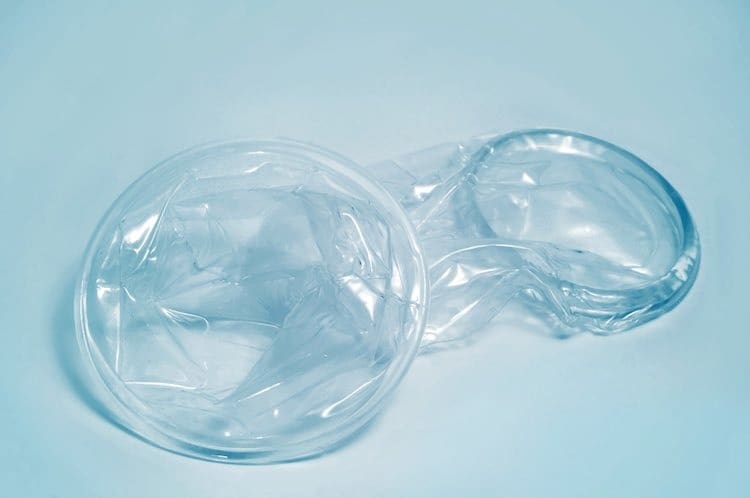
The female condom is a strong, soft and transparent sheath that is inserted into the vagina before sex, providing protection against both pregnancy and sexually transmitted infections (STIs). The female condom loosely lines the vagina and cervix, acting as a barrier to keep sperm from reaching the woman’s egg (ovum) so that it can’t be fertilised.
Female condoms are made of a type of thin plastic called polyurethane, and are about 15 cm long. They have a flexible ring at either end – an inner ring at the closed end and a larger, outer ring at the open end – which help keep the condom in place during sex.
Effectiveness at preventing pregnancy
The effectiveness of a contraceptive method can be measured for perfect use and typical use.
- Perfect use is when instructions are followed precisely. The failure rate for perfect use of female condoms is about 5 per cent.
- Typical use is what tends to happen in reality. Typical use failures include failures due to incorrect use. The failure rate for female condoms is about 20 per cent in the first year of typical use.
Using a female condom
The female condom can be inserted into the vagina up to 8 hours before intercourse. The condom is pre-lubricated, but additional lubricant can be applied. Both water-based and oil-based lubricants can be used.
The edges of the inner ring (at the closed end of the condom) should be squeezed together and then inserted as far as possible into the vagina. Once inserted, the inner ring will open and hold the condom in place. Then, place your fingers inside the condom and push the condom up into the vagina, making sure the condom is not twisted. The outer ring should sit at the opening of the vagina.
During sex, hold the outer ring in place. Guide your partner’s penis into the female condom to make sure that it doesn’t enter the vagina outside the female condom.
After sex, twist the outer ring, gently pull the condom out of your vagina, and dispose of it.
Advantages
- Female condoms can provide protection against sexually transmitted infections (STIs).
- The menstrual cycle is not affected.
- Unlike a diaphragm, it does not need to be fitted.
- It can be inserted up to 8 hours before sex, so doesn’t have to interrupt sexual spontaneity.
- It can enhance the sexual experience, because the polyurethane condom transmits heat and the external ring can stimulate the clitoris.
- Female condoms can be used with both water-based and oil-based lubricants.
- Female condoms can be obtained without a prescription.
- They may be preferable to male condoms if the man has difficulty keeping an erection.
Disadvantages
- Female condoms are not as widely available as male condoms.
- Female condoms are more expensive than male condoms.
- They can be difficult to insert and remove.
- They can make a rustling sound during sex.
- When not used perfectly, female condoms are only about 80 per cent effective at preventing pregnancy.
