
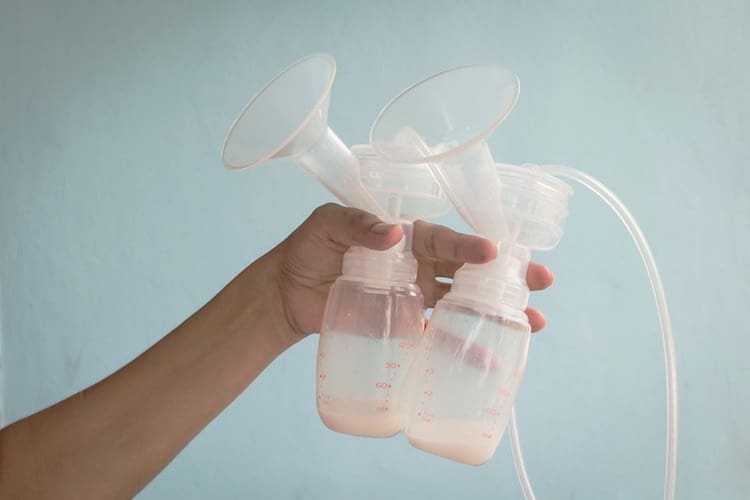
Why express breast milk?
There are a number of reasons why a breast feeding mother might wish to express milk rather than feeding the baby directly from the breast.
- Your baby may be premature and too small to suck properly. Your expressed milk can be fed to the baby through a tube.
- Some babies with a cleft lip or palate find it difficult to suck and need to be fed expressed milk with a special bottle or specially shaped teat.
- You may wish to leave your baby with someone else. Your expressed milk can be fed to your baby via a bottle, a cup, an eyedropper or a spoon.
- You may work outside the home and wish to provide breast milk for your baby when you are at work.
- Breast milk contains antibodies which will help protect your baby against illness — these can be especially valuable if the baby attends a day care centre with other children.
- You may simply wish to express a small amount of milk to mix with your baby’s first solid foods.
- To relieve severe engorgement.
- To relieve sore or cracked nipples.
- To maintain or stimulate lactation.
How can you express breast milk?
There are several ways you can express breast milk. It’s usually a good idea to find a warm, quiet, comfortable place and to relax first (such as by having a warm drink). A warm shower beforehand can be helpful. It is easiest to express small amounts frequently, such as 8 to 10 times a day. Always make sure your hands are clean before you start.
By hand
Expressing milk by hand needs practice, and you may want to enlist the help of a midwife or lactation consultant. There are slightly different methods, but the main aim is to assist the ‘let down’ of milk and drain the milk sinuses. To stimulate the ‘let down’ you have to massage the breast. Stroke down towards the nipple and gently roll the nipples between your fingers.
Then, to drain the milk sinuses, put your thumb on top of the areola (the dark circle of skin around the nipple), well away from the nipple itself, and your first 2 fingers on the bottom of the areola. Rhythmically squeeze them together. Do not press too hard. Work all around the areola, repeating this action. The aim is not to squeeze the nipple (which is just a nozzle), but the milk stored behind the nipple.
Keep expressing like this until the milk flow slows down to a drip, and then do the same on the other breast.
The milk comes out in small bursts at first and then flows freely. The amount of milk that can be produced varies from person to person. At first, it may be just a few millilitres. The entire procedure should take 20-30 minutes.
Using a pump
Whether you use an electric or a hand vacuum pump you still have to stimulate the let down as you would if expressing by hand. You must do this before you apply the pump to drain the milk sinuses. When using a pump, be careful not to exert too much suction on the nipple. Pumps can occasionally be a bit fierce and crack or split the nipple. If you have a healthy term baby and you are using your own pump and equipment, they do not need sterilising after use, just cleaning thoroughly to remove all milk.
How to store expressed milk
It is best to express directly into a sterilised container. The milk can be kept in the fridge for 48 hours at 4°C without losing much nutritional value or protective immunological effect. However, it is safe to keep in the fridge for 3-5 days.
Breast milk can be kept for 3 to 4 months in the freezer compartment of a fridge (that is, a freezer compartment with a separate door). If the freezer compartment is inside the fridge and does not have a separate door the milk may be stored for up to 2 weeks. Milk can be stored for 6 to 12 months in a deep freezer (-18°C).
Store the milk in small amounts. Glass or plastic containers can be used, including sealable plastic bags. Label each container with the date, month and year. Also write ‘expressed milk’ on the container in case someone mistakes it for something else. Do not add fresh, warm expressed milk to milk that is already frozen or cold.
How to thaw expressed milk
Frozen milk is best thawed by holding the container under cold running water, then gradually increasing the warmth of the water to bring the milk to body temperature. Do NOT microwave it. Breast milk is not homogenised (where milk, fats and so on are all mixed together), so it will separate. Swirl gently to mix. Do not leave expressed milk standing around at room temperature.
If the milk has been unfrozen in the refrigerator but not warmed, it can be stored in the fridge (but not re-frozen) for another 24 hours; if it has been thawed outside the fridge, in warm water, it can be kept in the fridge (but, again, not re-frozen) for another 4 hours; if the baby has begun drinking, the unused portion must be discarded.
Getting help
There are lots of people who can help you learn to express breast milk painlessly and efficiently. Try a midwife, lactation consultant, community child health nurse or your doctor.
