
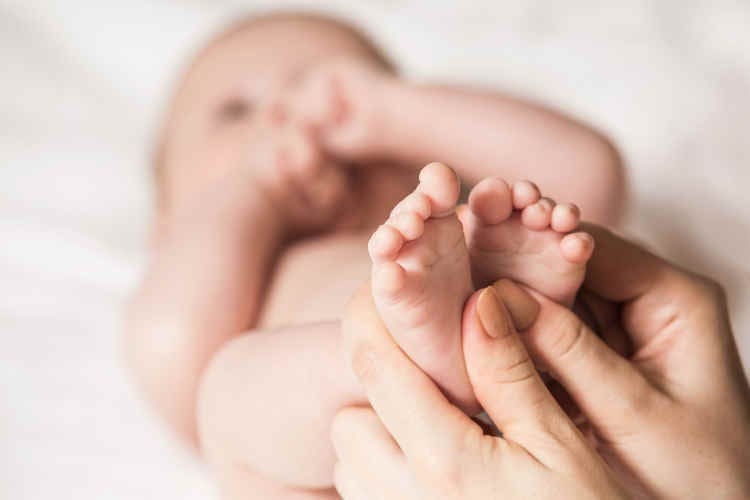
While some senses are more developed than others, babies can see, hear, smell, taste and feel from birth. Find out how developed your newborn baby’s senses are, keeping in mind that not all babies develop at the same rate.
Sight
Your newborn baby will be able to see you, although her vision will be a bit blurry. A newborn baby can see close-up objects and is attracted to faces, but can’t see distant objects well.
Newborn babies can see black and white and some other high contrast colour combinations. They can make out shapes by the contrast between light and dark.
By about 4 weeks, your baby will start to focus both eyes together to see objects about 20-30 cm away, and will watch your face while being fed or talked to.
By 2 months, babies can see a lot more. They are more interested in toys, can recognise their parents’ faces, and may have started to follow moving objects with their eyes. They are starting to see colours.
And after 3 months, babies can recognise familiar objects and people from a distance, and begin to use their eyes and hands in coordination.
Babies who have vision problems may experience developmental delays, so it’s important to get any issues checked out early.
Smell
Newborn babies generally have a good sense of smell, and from birth are able to smell both good and bad odours. Most babies will show a preference for their mother’s smell, especially her breast milk, within a few days of birth.
Cuddling your baby, when they can smell you, helps your baby to bond to you. Familiar smells can help soothe your baby. Most babies don’t like strong smells, such as perfumes.
Hearing
Babies can hear in the womb. They are born with fully developed hearing and are already familiar with their mother’s voice when born. Very young babies seem to prefer high-pitched voices, but can often be soothed by soft, calming noises.
By about one month, babies respond to loud noises by blinking, startling or frowning. Loud noises may also wake your baby from a light sleep. Your baby may also let you know that they can hear everyday noises, but the response to these noises is usually much more subtle. They may start moving their arms and legs about, or change their sucking rhythm while feeding in response to the noises around them. Over time, babies tend to get used to this everyday background noise and start to tune it out.
By the end of 2 months, babies can differentiate voices (especially their parents’ voices) from other sounds, and respond to them. And by 3 months, your baby will smile at the sound of your voice and turn his or her head towards the direction of sound.
If a baby has hearing problems it can delay the development of speech and language skills, so if you have any concerns get your baby’s hearing checked out. The earlier a hearing problem is detected, the better the outcome in terms of speech and language.
Most Australian babies born in maternity hospitals will have a hearing screening test before they leave hospital and all states and territories run neonatal hearing screening programs for babies in the first few weeks of their life. Around one in 1000 babies will have a permanent hearing loss.
Touch
From birth, your baby is sensitive to touch and pain.
Skin-to-skin contact between the mother and baby in the first hour after birth is strongly encouraged where possible and there is scientific evidence to support this in terms of improved breastfeeding, lowered stress for the baby and mother, and increased bonding between mother and baby, among other things.
This skin-to-skin contact in the immediate hour after birth stimulates the baby to go through the so-called instinctive stages, which are believed to help coordinate the baby’s 5 senses.
Newborns are soothed and comforted by stroking, cuddling and swaddling (being wrapped up snugly in a blanket or sheet), as it helps them feel secure.
Taste
Even though babies are only fed breast milk or formula at first, they are able to taste different flavours. Babies can taste differences in breast milk, depending on what their mother has eaten. In general, babies prefer sweet tastes to sour or bitter tastes. They are biologically programmed like this – possibly so they find breast milk palatable, attractive and soothing.
Interestingly, the flavour of foods a mother consumes during pregnancy and when breastfeeding can influence an infant’s acceptance of these flavours later on. So, eating a healthy diet during pregnancy and when breastfeeding will increase the chance that your child will prefer healthy foods. If possible, it is recommended that mothers breastfeed for at least 6 months.
Infants who are formula fed don’t have the opportunity to be exposed to a wide variety of foods after they are born, unlike babies who are breastfed and who are exposed to their mother’s diet constantly via breastmilk. But they do get the opportunity when in the womb, when flavours from the mother’s diet are transmitted through amniotic fluid. Studies have shown that formula-fed infants ultimately do not have such healthy dietary patterns as breastfed infants, reinforcing the importance of healthy eating during pregnancy to expose the unborn baby to lots of flavour experiences.
Developmental milestones
While not all babies develop at the same rate, there are certain things that they should be able to do by certain ages. These are known as developmental milestones. By taking your baby for regular health checks, your doctor can keep an eye on your baby’s progress.
