
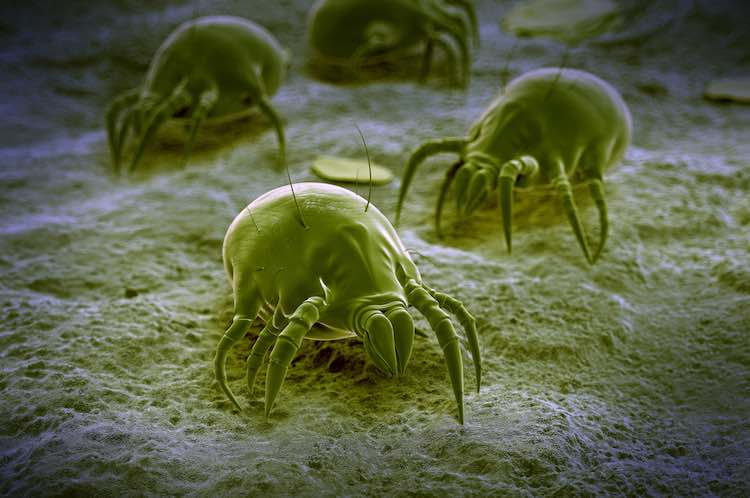
A common asthma trigger in Australia is the house dust mite, which has adapted to live by the tens of thousands in the dust of our houses, generally in bedding, mattresses, cushions and soft furnishings.
What is a house dust mite?
House dust mites are tiny creatures, usually not visible to the human eye — they measure about one-third of a millimetre in length. They are relatives of spiders and ticks. The house dust mite survives by eating the many dead skin cells that each of us sheds every day, along with pollen grains, insect scales, dead mites and even its own droppings.
Our dead skin cells are a main component of household dust. If dust builds up in areas of the house where the air is a bit damp (humid), this dust is likely to contain dust mites, as they not only need food to survive, but also moist air.
High numbers of dead skin cells are shed in the bedroom, accumulating in mattresses and pillows as we sleep, making the bedroom a favoured haunt of the house dust mite.
Natural climate patterns can favour the build-up of dust mites in houses, and some areas of Australia are more favourable for dust mites than others. The coastal regions with higher humidity and warmer temperatures have higher household dust mite levels than inland areas with a drier climate and more extreme temperatures.
Dust mites and asthma
Dust mite droppings can become airborne and are so small that they can flow deep into your airways each time you take a breath. These inhaled droppings, rather than the mite itself, can then cause asthma in sensitive people by means of an allergic reaction, leading to the typical asthma symptoms of wheeze, tightness in the chest, coughing and difficulty breathing.
Dust mite droppings are sometimes called dust mite ‘allergen’ due to this ability to trigger an allergic reaction in some people. Often dust mite allergy also causes inflammation in the nose, called perennial (meaning persistent or year-round) allergic rhinitis, which results in sneezing, a blocked and stuffy nose or a runny nose.
Although the greatest number of dust mites is found in the bedroom, their droppings can become airborne when dust is disturbed — as occurs when people move within the house — and spread, making any part of the house a source of this allergen for someone who has a house dust mite allergy.
Dust mite allergy diagnosis
Although many people with asthma will be sensitive to the allergen in house dust mite droppings, your doctor may suggest that you have skin-prick tests or blood tests to confirm whether or not you have this allergy. Having your symptoms improve when you go on holiday, or stay somewhere other than your house, may also indicate to your doctor that dust mites or another trigger in your home may be causing problems with your asthma.
Dust mite allergen avoidance
Reducing your exposure to house dust mites, through a combination of allergen reduction strategies, may improve asthma symptoms and control for some people who are allergic to house dust mites. However, single interventions to reduce exposure to dust mites are unlikely to effectively improve asthma.
If you are thinking of trying allergen reduction strategies, which can be inconvenient and expensive, the National Asthma Council advises that you first see your doctor to confirm the diagnosis.
Reducing house dust mites
In the past, chemicals were thought to be the best way to control dust mites, however, it is now believed that measures that make your house a less favourable habitat for dust mites is a better approach.
Most advice for controlling dust mites centres around:
- improving ventilation in your house to avoid the build-up of moist air;
- selecting flooring and furniture that is easy to clean and does not encourage the accumulation of dust and dead skin cells; and
- using household cleaning methods that are effective in removing or killing dust mites, for example, using a damp or electrostatic duster and mop.
If you live in a humid, coastal area eliminating dust mites completely is difficult, but you can aim to reduce their numbers significantly.
| Reducing dust mite levels in your home |
|---|
| Enclose mattresses, doonas and pillows in dust mite-proof covers. These covers must be washed every 2 months. |
| Wash bedclothes in hot water (more than 55 degrees Celsius) once a week. If you can’t wash in hot water, use a commercial product formulated to kill dust mites in cold water. |
| Use pillows that are made with anti-microbial treatments that supress dust mites. |
| Clean non-carpeted floors with a damp or electrostatic cloth, mop or steam mop rather than using a vacuum cleaner. |
| Clean carpets weekly with a vacuum cleaner that has a suitable filter such as a HEPA (high efficiency particulate air) filter. However, even this type of filter briefly increases the amount of house dust mite allergen in the air after vacuuming. It’s therefore best if the allergic person does not vacuum and does not enter the room for 20 minutes after it has been vacuumed by someone else. |
| Dust surfaces with a damp or electrostatic cloth weekly. |
| Remove fluffy, stuffed toys from your child’s bedroom. Although putting this type of toy in the freezer overnight once a fortnight can kill mites contained in the toy, this does not remove the allergen. Washing these toys in hot water once a week is the best approach. |
| Remove soft, upholstered furniture from the bedroom, as well as any unnecessary bedding, such as extra pillows or cushions. |
| Select furniture that is upholstered in vinyl or leather rather than cloth. Blinds or shutters are easier to clean than heavy curtains. |
| Ensure good ventilation throughout your house to avoid moist air build-up, which occurs with cooking, bathing, showering and, more simply, as a result of people breathing inside the house. |
| Avoid using unflued gas heaters and evaporative coolers (water cooled air conditioners) in the home, as they can emit water vapour and lead to an increase in dust mite levels. |
Allergen immunotherapy
Allergen immunotherapy may help improve asthma control in some people with asthma who also have allergies, including dust mite allergy.
Allergen immunotherapy involves taking allergen extract (either as injections or medicine taken under the tongue) to help desensitise you to the dust mite allergen. Immunotherapy should be given only under the guidance of your doctor or specialist because of the potential for serious side effects. If you respond, the treatment usually needs to be continued for about 3 to 5 years.
Talk to your doctor about whether immunotherapy may be suitable for you.
